Showing posts with label teaching. Show all posts

Friday, January 31, 2014

hypokalemia and metabolic alkalosis

A few years ago I was talking one of my mentors at Kidney Week, John Asplin. He mentioned
that he taught an integrated lecture on metabolic alkalosis and hypokalemia. I thought this was an inspired idea.

Teaching separate classes on both subjects results in a lot of overlap because the renal mechanisms for both disease are the same, this means that many of the diseases that cause one, also cause the other.

Additionally hypokalemia can cause metabolic alkalosis and metabolic alkalosis can cause hypokalemia, so it makes sense to teach both of these conditions in an integrated lecture.

Lastly, teaching each electrolyte individually in isolation from each other is a missed opportunity. One can only appreciate the beauty of electrolyte physiology when one understands how each electrolyte fits together and how abnormalities in one is associated and affects all of the other electrolytes.

Unfortunately, I botched the lecture. I gave this lecture for the first time for the Oakland University Beaumont Medical School this past August. I knew it didn't go too well, but this week I received the class feedback. Overall my statistical evaluations were excellent but when I read the comments the students were jackals. They savaged this lecture.


Timing was on my side, I was scheduled to give this lecture the day after I received feedback. I'm not done tweaking it but what I did for my Tuesday lecture was add more connective tissue between the concepts, and fill in with some additional summary slides.

Right now, I'm using it as a lecture to follow-up my potassium lecture, but at OU the students didn't have any baseline potassium knowledge. In order for this lecture to work the students must already understand the basics of potassium, especially the central role that renal potassium handling has in potassium homeostasis. Hopefully I will be able to negotiate another hour into the GU schedule for this lecture.

My next plans for this lecture is to cut out a lot of the opening slides. The purpose of those slides is to quickly move from introducing potassium and hypokalemia to getting to the truth that hypokalemia is almost solely a disease of increased renal losses.

I want to add a slide about disease opposites:
  • Pseodohypoaldosteronism type 1 and Liddle syndrome
  • Godon's syndrome and gittleman's syndrome
  • Adrenal insufficiency and AME
I want to add some slides on how hypokalemia causes (specifically, maintanes) metabolic alkalosis and then how metabolic alkalosis causes hypokalemia.

Here is the lecture (Keynote version | PDF)

Friday, October 21, 2011

Blogging as an academic endeavor

From Skeptical Scalpel (twitter)
Since I dropped out of the business of training residents, I have been actively blogging and not cranking out mindless publishable research. Here is an interesting fact. I have no doubt that far more people have read what I have written in my blog for a year and a half than ever read all of my 95 published works combined.
Sing it brother! It takes me about a hundred hours to prepare a de-novo talk for grand rounds. I will then deliver it to an cohort of 50-80 docs with a collective GCS of 10. After the last audience question the lecture video will be filed in the medical library never to be found again. The lecture is not searchable or discoverable and the work is largely lost.

An average post at PBFluids will get more views than the grand rounds in the first few days and if it is linked by RenalWeb other aggregator it will get enough page views to fill one of the great conference halls of the national meetings. After the first week the post continues to be an eternal flame of searchable and discoverable data. To me the relative impact tips way toward blogging as a more significant form of academic communication but to the powers that grant career advancement it is a meaningless toy.

Sunday, October 9, 2011

Dogs, squirrels and evolution

This is my dog Bo.
Bo is a Woodle. I wanted to name him Chewbacca.


He loves to chase squirrels.
On google image search the top suggested related-search for squirrels is squirrels with guns
He was chasing squirrels all over my neighbor's lawn, much to the delight of the 6-year old twins that live there. I proceeded to tell them the story of the only time Bo caught a squirrel.
I was jogging with Bo and he saw a squirrel. He chased the rodent for 10 feet until the squirrel climbed a tree. Bo looked up the tree and tried to jump a few times but the squirrel was too high. I told Bo that maybe he'd catch the next squirrel and we started to run down the block. Then the squirrel fell out of the tree and landed right in front of Bo. Well, Bo grabbed that Squirrel in his jaws and killed it faster than you could say "rabies shot." It happened so fast all I could remember was the sound of his little lungs being punctured by Bo's teeth. (Six year olds love the gory details. Bilateral pneumothorax, gotta be a quick way to die.)

Then I asked the twins, do you think that squirrel was a good climber?

They answered, "No."

Do you think that squirrel's babies would be good climbers?

They answered, "No."

Do you think that squirrel is going to have any more babies?

They answered, "No."

That's why squirrels are so good at climbing trees. The ones that are bad at climbing, die and can't have babies. We call that evolution.
And I call that a teachable moment.

Come on America, Its not that hard.

Gallup Poll Feb 2009

Level of support for evolution from wikipedia

Wednesday, August 24, 2011

Crazy idea or genius? Nephrology Merit Badges

I want to create a series of buttons to give to residents and students to mark achievements in nephrology.

My birthday is coming up, looking at the 1 inch beginner button system

One of the common resident complaints regarding nephrology is that it's too hard. The nephrologist response to this complaint  is usually to deny the difficulty, because its not hard for the nephrologist. Perhaps that denial is counterproductive, first it's hard to disrupt a widely held belief that is continually reinforced by the community of medicine, secondly when you deny the difficulty you insult the intelligence of the student struggling with new concepts. Its essentially saying, "Hard? differentiating among the pulmonary renal syndromes is easy, what are you stupid?"

Instead of denying the difficulty we should re-frame the meme. Yes, nephrology is hard and look how cool it is that you mastered these concepts.

Merit badges, or pieces of flare as my fellow interjected, would add levity and encourage residents to tackle deeper concepts.


Potential nephrology merit badges:
  • It's the heart, no it's the kidney, no it's the heart, no it's the kidney...: diagnose and successfully treat a case of cardiorenal syndrome
  • ABG guru: interpret ABGs showing all four primary acid-base disturbances
  • Quinton: insert a temporary dialysis access to provide emergency dialysis access
  • Tissue is the Issue: perform a renal biopsy
  • Look Closely: correctly interpret a urine microscopy specimen
  • K/DOQI Genius  : use the K/DOQI guidelines to craft a plan of care for a CKD patient
  • RIFLEry: use the rifle criteria to correctly stage a case of AKI
  • RTA (pronounced like Fonzie would RTAAAAAA!): use urinary anion gap and other clues to correctly diagnose and classify an RTA
  • Bud Rose: use free water clearance to draw meaningful conclusions about hypo- or hypernatremia
  • Put on your Helmut (Rennke): be a star in the pathology room
  • Gerry Appel: exceptional management of nephrotic syndrome
  • Ron Falk: diagnose and manage a patient with ANCA-associated vasculitis
  • The Town Schrier: Use FENa, FEUrea and BUN:Cr ratio in a meaningful way to diagnose a subtle case of pre-renal azotemia
  • Mark Halperin: Master of the Cortical Collecting Duct: use the TTKG equation intelligently to help in the management of a patient
  • Wisdom of Solomon: prevent a case of contrast nephropathy
  • Cry me a river: for expertise in the use of high dose diuretics
  • EPA Super Fund Site: use dialysis to correct uremia in AKI

Suggested merit badges from other creative nephrologists:
  • Way to Go KDIGO: use the KDIGO guidelines to do what ever you want to your dialysis patient 
  • Golden Pocket: Forgetting to tighten the cap on the urine that you are bringing back to the lab to spin
Thanks to Steve Rankin and Edgar Lerma

Sunday, August 7, 2011

Wednesday, July 6, 2011

I love the smell of July 1st in the morning

As has been the tradition since 2008, I had the honor of giving the morning report on July 1st for the St John Hospital and Medical Center Internal Medicine Residency Program. July one, openning day of the academic year. The conference room was crackling with the energy of fresh interns and the equally excited second years ready to run their own teams.

Giving the lecture was a lot of fun. There were a lot of insightful questions, some because the questioner is terrified and others to show how smart she is. Nobody looked sleep deprived, so the ratio of deer-in-the-headlights to asleep-at-their-desk was unnaturally high.

The lecture covered three topics:
  1. total body water and how to choose an IV fluid
  2. diuretics
  3. dysnatremia
There is no way I could get through the deck in the 50 minutes of time we had. It probably would take 90 minutes to cover it all. In delivering the talk I focused on the mood of starting this great adventure.

Here are some tips to using this presentation:

The first slide has Munch's Skrik, which I explain translates as July 1st


Slide 4 has my favorite quote about kidney function. Homer Smith essentially uses 150 words to explain the point that the job of the kidneys is not to make urine anymore than the job of a factory is to make smoke.
The lungs serve to maintain the composition of the extra-cellular fluid with respect to oxygen and carbon dioxide, and with this their duty ends. The responsibility for maintaining the composition of this fluid in respect to other constituents devolves on the kidneys. It is no exaggeration to say that the composition of the body fluids is determined not by what the mouth takes in but what the kidneys keep: they are the master chemists of our internal environment. Which, so to speak, they manufacture in reverse by working it over some fifteen times a day. When among other duties, they excrete the ashes of our body fires, or remove from the blood the infinite variety of foreign substances that are constantly being absorbed from our indiscriminate gastrointestinal tracts, these excretory operations are incidental to the major task of keeping our internal environments in the ideal, balanced state.  
Slides 5-9 emphasize that this topic is not a niche topic, the issues of fluids and electrolytes comes up everyday, on every patient.


Slide 11, warn everyone that the unfortunate person who gains 30 kg in this slide is a medicine resident gorging on donuts at morning report.


Slide 18, remind everyone that LR is for surgeons. Deny any knowledge of the reason for this peculiarity. Explain that this is further evidence that they are an alien species unrelated to hard working, honest IM docs.


Slide 27 Explain that the question, "Would you give a drowning man a glass of water?" was taught to me by one of the most foul-mouthed senior residents when I was an intern. I want to show that the lessons learned this year will be the stories you tell interns decades later. Interns will learn more this year than any other year of their life, except their first year of life.


Slide 29 recommend everyone read House of God. 


Here is the lecture in PDF and Powerpoint

Monday, June 6, 2011

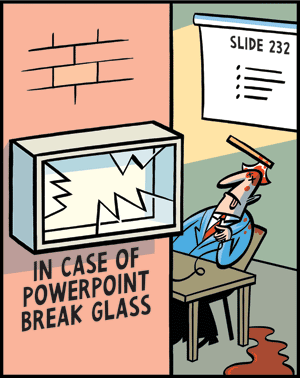
Not "Death by PowerPoint" but "Death Star by PowerPoint"

I love this scene in Star Wars because it is pretty rare in movies to see a formal lecture. The presenter, General Dodonna, knocks it out of the park.


What if the Dodonna used Powerpoint?


Garr Reynolds from Presentation Zen deconstructs Dodonna's presentation style and compares it with contemporary powerpoint presentations. FYI, anyone who wants to do a better job creating and delivering presentations should be reading Presentation Zen.

Here is a movie with the same idea from YTMND:


Monday, April 11, 2011

Lecture on how to give a lecture

This post really resonates with me: The Ten Commandments of PowerPoint and I wish that I had included it in my lectuer from last week on how to give a lecture.

The chief resident at St John Hospital and Medical Center asked me to do morning report on giving better presentations. It was an interesting project. I have been pretty busy and didn't have enough time to put together a really polished presentation, but this is what I came up with.

Here is a link to the PDF and Keynote file (130 mb)


iWork documents are a little wonky if you are not using Safari. So the videos I embedded in the lecture are below if you are having trouble looking at them.

Steve Jobs tells it how it is regarding Microsoft


The birth of a morning report:


Screen captures with command-shift-4:


Smart builds


Highlight text:


Mask an image


Improve a crappy figure:

Tuesday, January 25, 2011

ASN Renal Week Day 2: Harrisons, UpToDate and the Renal Fellow Network

I grabbed dinner with Matt Sparks, one of the driving forces behind the Renal Fellow Network. It was a great dinner and, for me, was the first time I had a chance to talk shop with another blogger. Very fun. One of the things we discussed was the role of blogs in fellow education (this idea was matured a little with a discussion with Conal O' Seaghdha, the other half of inspiration that drives RFN.

I believe that the primary educational material for medical education has gone through three phases. In the beginning was the medical text book. This was exemplified by Harrisons which rose to ascendancy not by being the first text book but by being the most innovative. Harrison unique innovation was arranging the sections by patient complaint rather than by disease. Here it is described in a fascinating history of the Harrison family of doctors:
PRINCIPLES OF INTERNAL MEDICINE would offer medical students a new way of approaching patients. The Cecil Textbook of Medicine, which had previously monopolized the American medical textbook market, took a less helpful approach. Its author, Russell Cecil, M.D., of Cornell Medical School in New York, had organized the textbook exclusively by disease, offering the definition, cause, symptoms and signs, methods of diagnosis, treatment, and prognosis for each one. This meant, of course, that a student must identify the patient's disease before the book would offer help. Principles of Internal Medicine, on the other hand, began with the patient. Tinsley [Harrison] devoted the first third of his textbook to symptoms and signs experienced by sick people, which included shortness of breath, swelling of the feet, and so on-leading from there to understanding the disease. The text mirrored the ideal practice of a physician. The first edition of his book, published in 1950, proved an instant and major success.

The second phase was UpToDate. Burton "Bud" Rose (how can Wikipedia not have an entry on Dr. Rose?) crushed the primary medical references by creating a comprehensive, readable and searchable reference. He also cajoled his authors to make specific treatment recommendations so Up-To-Date is the only medical reference that actually teaches you to take care of patients. One of my friends used to complain that when she would invest the hours and tears needed to read a chapter of Harrison's she would finish with tremendous knowledge and the ability to shine on atending rounds but have no idea how to treat her patient. UpToDate is not like that and has probably saved more lives than ACLS. I routinely ask prospective fellows about their reference of choice and for three years running every single one of them has answered "UpToDate."

As good as UpToDate is it has some weaknesses. The EBM zealots take it to task for relying on expert opinion but I really don't have too much concern about that (my previous post on that took them to task for saying they are EBM when they are really an expert opinion source. That's why the list of author/editors is so important and impressive. They should be proud of what they are rather than claim to be EBM) .

What concerns me is UpToDate's inability to escape its CD-ROM DNA. I have been a subscriber to UpToDate since I was a resident and Burton Rose was still answering the phone to deal with bad CDs and pimping the still incomplete product in the hallways of Renal Week. The ascendancy of the Internet has allowed UpToDate to get out of the CD shipping business but they still refuse to link out even when it makes overwhelming sense. All of their articles are fully referenced, but not with links to the primary data or the pubmed reference but to an internal database record of the reference.

I get that isn't too hard to copy the PMID and drop it into google and that will pull the article, but why doesn't UpToDate just link-out?


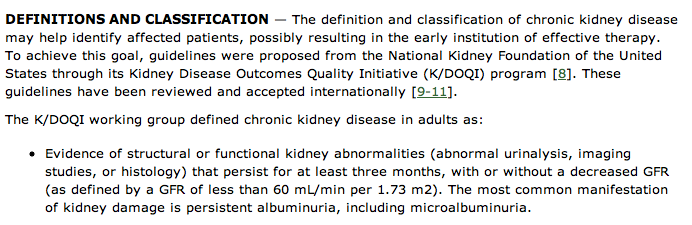
This goes for other area where a link out makes sense. Here is a segment of UpToDates card on "Overview of the management of CKD in Adults"


Wouldn't you expect, reference 8 to take you to the K/DOQI guidelines. They are free and available on the internet. UpToDate instead links to their internal reference of the AJKD supplement with the original publication of the K/DOQI guidelines, which are behind an Elsevier pay wall.


It feels that the editorial rules for UpToDate were created in the CD-ROM era of the 90's and haven't been updated for the internet era.

I beleive that, just as Harrison had an openning in the Internal Medicine textbook space by using patient oriented complaints to organize his text and Rose had an openning by using search and a unique editorial style, the technology of today provides a niche. I want an interactive textbook of medicine with comments, a Facebook "Like" button, a way to connect with other practitioners and share treatment pearls.

The renal fellow network and other knowledge focused medical blogs are early progenitors of this future but some pretty large problems need to be addressed:

  • Organization. Blogs are reverse chronologic order by convention but given the random way that topics get posted, it makes for an unorganized structure. Solutions that are being used now include search and tags. Unfortunately, the tag clouds are so huge that they border on the useless. Search is good but a more structured table of contents and/or index would be great. I am delighted with the addition of the lecture and handout tabs on PBfluids, its a step that allows, at least me, to find things I have posted here before.
  • Expiration of old data. Medicine is always evolving. Today's truth is tomorrow's MMR-autism fiasco. These medical blogs need a way to mark expired information as such. A perfect example is the ATN trial by the VA and NIH. Prior to that study I was firmly in the more dialysis for acute kidney injury camp. After that was published I marked my acute kidney injury lecture, as being pre-ATN trial. This meant something to me, but my readers likely had no idea what that meant. How many other educational resources were obsoleted by that medical about-face?
Nephrology on demand looks like they are another group making good progress in this mission. Look out UpToDate, Web 2.0 has you in our sights.


- Posted using BlogPress from my iPad

Tuesday, January 18, 2011

Just gave grand rounds on hemodialysis


The title for the talk was dialysis for the internist and I focused on recent advances in the field of hemodialysis including:

  • Plavix for fistula maturation. Doesn't work.
  • Aggrenox for graft preservation. Does work.
  • HeRO grafts for patients with central venous stenosis
  • Poor outcomes for nursing home patients started on dialysis
  • Poor outcomes for the elderly on dialysis
  • Evidence base for selecting conservative care rather than dialysis
  • Early versus late start for dialysis
  • Frequent hemodialysis
  • APOL1 as the cause of increased risk for kidney disease among African Americans
Keynote has a feature that allows people using Safari to view the presentation. Here it goes. We'll see if this works. Otherwise, the PDF and Keynote files will be available under the Lecture Tab.

Here is a video of me giving the lecture. I'm working on putting together a formal slidecast but the video was a WMV. What a hassle.


Hemodialysis for the Internist. An Update from joel topf on Vimeo.

Monday, January 17, 2011

Found an old lecture


In 2006 I had to give the fellows a lecture on nocturnal dialysis. I remember being delighted with how it turned out. It was a fellow-level lecture that would have little appeal to non-nephrologists. The lecture goes into the different ways to measure dialysis dose and deep-dives into the National Cooperative Dialysis Study and the HEMO trial.

A month or so after giving the lecture I had a hard drive crash. After that, I couldn't find the lecture.

Well, today I was mucking through an old external hard drive and found the lecture! Yay me! I backed it up!

If you are interested the lecture is now resting safely under the Lectures Tab.

Friday, January 7, 2011

New Lecture Tab.

I gave a lecture to the internal medicine residents of Saint Johns today. The lecture was case based and focused on non-anion gap metabolic acidosis. Later, I received this e-mail:
Dear Dr Topf,

I appreciate your lecture this morning on Non-anion gap metabolic acidosis, I tried to get a copy from your website, but i couldnt find it. I would appreciate if I could get a copy

Thank you,
Saif
Saif, you want it? You got it.

Look above and next the Blog and Handout tabs is a brand new tab, Lectures.

If the presentation is a powerpoint-style slideshow then I'll post it under that tab. If the lecture was paper based then look under Handout for the supporting material.

Enjoy.

Friday, August 13, 2010

The iPad needs a content creation system

The iPad is screaming out for a system to make interactive content designed for that intimate touch based user interface.

Powerpoint is a computerization of the old-fashioned photographic slide. This metaphor is continued down to the presentations being called decks. The iPad needs a presentation software as slick and versatile as Powerpoint and Keynote are but is constantly aware that the audience is a single person rather than a room. With that knowledge of an audience of one the program should explode interactivity.

Audience response systems can be grafted on to slide decks but questions and interactivity should really be central to the iPad presentation experience. Change the presentation from a slide show to an exploration.

I don't think it was a coincidence that Steve Job reminded everyone of HyperCard during his interview with Walt Mossberg at the D conference. I don't think it was deliberate name dropping but rather he had been spending a lot of time thinking about the strengths and weaknesses of that technology because he is guiding and overseeing the development of a similar technology to be authored on Macintosh's and consumed on iPads.


This program should be akin to Garageband, iDVD and Keynote. Consumer grade software that allows an amateur to produce pro-level documents. Imagine using an interactive iPad program is the followng situations:

  • Teachers could produce class room materials, such as course packs, lab manuals or study guides
  • Restaurants could develop menus with wireless ordering
  • Conferences could create on-the-fly lecture notes with interactive commenting
All of this could be done with Objective-C but the idea would be to expand the market of content creators from sophisticated programmers to the entire universe of knowledge workers. Done right this would create an explosion of iPad specific content. and hopefully relieve med students of the endless dreary morning reports and noon conferences.


Reading David Pogues review of Google App Inventor, it sounds like Google stumbled out of the gate. Let's see if this rumor is Apple's counter punch.

Friday, July 9, 2010

second lecture of the year: acute kidney injury


This is a significant upgrade from the version I posted a couple of years ago. I put the lecture together right before the ATN trial was published. I finally got around to updating the presentation to include that data. I also updated the NGAL section and added some data on avoiding volume overload.

I used a number of the posts on the blog to allow me to rapidly update the presentation. I was pleased with how well my ATN commentary/review stood up.

Thursday, June 24, 2010

I'm going to speak at ASN!

This came in the mail today:
Dear Dr. Topf:

On behalf of the American Society of Nephrology's (ASN) 2010 Program Committee and Postgraduate Education Committee, we are pleased to invite you to join the distinguished faculty for Renal Week 2010, November 16-21, 2010 at the Colorado Convention Center in Denver, CO.

Rocky Mountain High!

Tuesday, June 22, 2010

NephronPower's survey on Neph Ed

Kenar Jhaveri, MD, (Kidney 007), assistant professor of medicine at Hofstra Medical School and contributor to Nephron Power, is doing a survey on nephrology education. Go take the survey.

I don't want to spoil the survey but it mentions two resources I was not familiar with:

  1. Detective nephron
  2. Nephrology crossword puzzles
Check'em out so you can have an opinion.

Friday, April 16, 2010

Noon conference St John Macomb: Renal Adventures in Imaging

Yesterday I gave one of my favorite lectures, Renal Adventures in Imaging.

It is a lecture on three issues in nephrology that are not normally put together in a single lecture:

  1. Phosphate nephropathy
  2. Nephrogenic fibrosing dermopathy (I'll never get used to calling it nephrogenic systemic fibrosis because, despite what the literature states, all five patients I have seen had purely dermatologic manifestations)
  3. Contrast nephropathy
I like the lecture because it is not a typical nephrology lecture. 

I gave the lecture Seder-style and had crammed for the last three days getting the booklet ready. It's the longest booklet by one sheet (32 pages rather than my standard 28). It turned out pretty good, though the acetylcysteine section needs to be built up and I need to comb through it for typos.

Friday, March 12, 2010

Lecture for the St John Residents

I have been doing a monthly fluid and electrolyte conference for the residents at St. John. Today we did a case of hypernatremia initially due to hypercalcemia and then due to nephrogenic diabetes insipidus.


Related Posts Plugin for WordPress, Blogger...