Showing posts with label uptodate. Show all posts

Sunday, September 16, 2012

Medicine 2.0: Conversations from the hallway


This week-end I am in Boston at the Medicine 2.0 Conference. It has been awesome. I am tweeting and bloggin about it at eAJKD (blog | Twitter)

At one of the sessions on medical education, I made a comment on Beaumont's mandatory medical student attendance. Afterwards, Brian Alper, the founder of DynaMed came up to me to talk. He started to tell me about Dynamed, I told him I was familiar. When I was working with the students on the Team Based Learning, a number of them told me how much they loved the product. They even told me that it was better than UpToDate, a statement that gave me chest pain.

I had to tell him about my terrible experience looking up Goodpasture's in Dynamed. He looked at me and said, "So, you're the one."

He was totally professional and pulled up the current version of the topic on his iPad. Wow! What a change. The topic looks completely rewritten and in a comprehensive style. It now has an author, a wide variety of treatment options including plasmapheresis and immunosuppressants. He told me that he would email me the topic. I plan on revising my review of DynaMed, but for now all I can say is that it looks a lot better.

Tuesday, September 4, 2012

Team based learning, reason for optimism about medical education


In general, as I have progressed through my education, I have felt that the quality of education has been on a downward vector.
  • I believe that duty hour work restrictions have diminished continuity of care and reduced the drive for residents to read and learn about their patients, because the patients feel less like "their patients."
  • I think the emphasis on fraud prevention that has meant that attendings need to see and be present for all of the meaningful aspects of patient encounters has diminished fellow autonomy and delayed the maturation process that senior residents and fellows undergo.
  • I think the addition of alternative medicine curriculum to medical schools is an inexcusable retreat from the goal of medical scientists.
But I have recently experienced a vision for the future of medical education at Oakland University William Beaumont Medical school and I am blown away. Don't worry future doctors are going to be just fine.

OUWB is one of the newest medical schools in the country and has it's first two classes of medical students enrolled, classes of 2015 and 2016. The second years are finishing up the renal section. It is an integrated unit including histology, pathology, physiology and pathophysiology. I was privileged to have an integral role in developing the curriculum. One of the parts that I spent hours on was developing Team Based Learning modules (TBL).

Typical MD Lab from Scott Hall
(http://conjoint.med.wayne.edu/mdlabs.php)
Team based learning is OUWB's version of the small group learning sessions that have always been a part of the first two years of medical school. During my years at Wayne State they were called MD Labs. The sessions were sprinkled through out the curricula. I went to a few and they were of widely variable quality. I didn't go to many, because they didn't count toward your grade. That told me that The Dean didn't think they were important enough to count so I took the hint spent my limited hours cranking on stuff that counted.


The TBL is a reinterpretation of those small group sessions that I see as wildly successful. The success is not by accident and comes from the novel structure of the sessions. A TBL is made up of preparation and three segments:

Prep

The preparatory reading is a chapter, or article or handout that covers all of the main ideas of the session. For proteinuria and glomerular disease the students were assigned a chapter in Harrison's. For CKD and AKI the students were given review articles in BMJ (Hilton R. 2006) and NEJM (Abboud, Henrich 2010). For Sodium and Water, I wrote a 41 page chapter on the subject. Be warned I have been told that it has a lot of typos.

Individual Readiness Assessment Test (iRAT)

As soon as the session starts the students have a multiple choice test of 10 questions. All of the answers should be found in the assigned reading. The test score is part of the students grade in the section. This means that all of the students need to do the prep work and all of the students need to show up for the session. Two huge improvements to the Wayne State MD labs.

Gunning for grades on the iRAT

    Team Readiness Assessment Test (tRAT)

    After completing the fill-in-the-bubble iRAT, the students then work in 5 person teams on the exact same questions they just answered. The teams have scratch off pads that work like instant lottery tickets with the correct answers. When the team answers a question they get instant feedback if they were right or wrong. This is closed book but the students all work together. After the all of the teams complete their tRAT there is a brief discussion of any questions that were troubling. The proctors walk around the room during the exercise and listen to the team discussions to they get a sense of what questions are difficult/poorly written.
    If you scratch off three horse shoes you win $60.
    Look at her notes. Every tricky nephrology
    question starts with "let's draw a nephron."

    Application Exercise

    Application questions are complex questions that supposed to integrate physiology and clinical medicine in to a complex multiple choice question. The questions are all open book, and in this age of WiFi, laptops and the WWW, we should really rename open book as open Google. The teams get 15-20 minutes per question and then simultaneously display their answer. Then the proctors lead a discussion on the reasoning behind the answers and different strategies the teams used to get to the answer.


    The things I love about the TBL


    • It is part of the grade. Curriculum directors need to understand that the medical school curriculum has more information than is possible to learn and students are rational actors. They will sacrifice important but uncounted learning opportunities in order to prepare for counted exams. There is no way to make something meaningful without making it part of the grade.
    • The iRAT happens right when the students walk in to the room. I love how this makes it clear that the students are being graded on preparation. The important thing is getting the students to learn the material before the session starts. This paragraph from Regis School of pharmacy states it perfectly:
    "To promote active and collaborative learning, students are sometimes asked to work in groups in class or on projects outside of class. While group work does benefit student learning, unfortunately it is often plagued by “social loafers”, or students who do not pull their weight in terms of helping the group. As a result, many students learn to dislike group work and may seek to avoid it. TBL is different. TBL ensures that each member of the team is held accountable for their own learning outside of class. Students who do not prepare adequately before class will perform poorly on the iRAT and will not be able to contribute in a meaningful manner to the tRAT and application exercises. As a result, most students who would normally remain “social loafers” in a group learning project are instead quickly motivated to do the assigned work out of class in order to perform well on the iRAT. In addition, as teams work together and compete with other teams in the class, loyalty to the team develops among each member. This further motivates the “social loafers” to prepare outside of class so that they can contribute and help the team succeed."
    In the cut throat world of medical school any system that allowed a "social loafer" to benefit from the group while contributing nothing would be a recipe for a short lived project. The iRAT gives a clear message: come to class prepared, or you will suffer.

    • The application exercises are open google. To me, this was the most interesting part of TBL. Clinical medicine is, of course, open book. Everyday I am consulting Dr. Google, Epocrates and UpToDate. My information gathering strategies were developed on the fly in my clinical practice. No one taught me these types of skills and no where in medical school were there any opportunities to practice hone them. The students of OUWB are working together, comparing notes, seeing which resources work best. I heard students explain the virtues of DynaMed (a POS in my opinion). I spoke with students who distanced themselves from Wikipedia until I told them I was a fan and had no reservations about using the crowd sourced encyclopedia. After hearing me extol its virtues they quickly changed their tune and agreed that it was easy to filter good from bad wiki pages (referenced, with mainstream journals, avoid political topics) and that the good ones never steered them wrong.

    People used, Google, Wikipedia, UpToDate and a strange
    resource called a "book" 

    Summary

    The portable computer revolution of iPads and smart phones allows us to bring the library to the bedside, it is time for medical schools to appreciate and embrace this pivot in the history if medicine. TBLs are the best example I have seen of of this.

    Tuesday, January 25, 2011

    ASN Renal Week Day 2: Harrisons, UpToDate and the Renal Fellow Network

    I grabbed dinner with Matt Sparks, one of the driving forces behind the Renal Fellow Network. It was a great dinner and, for me, was the first time I had a chance to talk shop with another blogger. Very fun. One of the things we discussed was the role of blogs in fellow education (this idea was matured a little with a discussion with Conal O' Seaghdha, the other half of inspiration that drives RFN.

    I believe that the primary educational material for medical education has gone through three phases. In the beginning was the medical text book. This was exemplified by Harrisons which rose to ascendancy not by being the first text book but by being the most innovative. Harrison unique innovation was arranging the sections by patient complaint rather than by disease. Here it is described in a fascinating history of the Harrison family of doctors:
    PRINCIPLES OF INTERNAL MEDICINE would offer medical students a new way of approaching patients. The Cecil Textbook of Medicine, which had previously monopolized the American medical textbook market, took a less helpful approach. Its author, Russell Cecil, M.D., of Cornell Medical School in New York, had organized the textbook exclusively by disease, offering the definition, cause, symptoms and signs, methods of diagnosis, treatment, and prognosis for each one. This meant, of course, that a student must identify the patient's disease before the book would offer help. Principles of Internal Medicine, on the other hand, began with the patient. Tinsley [Harrison] devoted the first third of his textbook to symptoms and signs experienced by sick people, which included shortness of breath, swelling of the feet, and so on-leading from there to understanding the disease. The text mirrored the ideal practice of a physician. The first edition of his book, published in 1950, proved an instant and major success.

    The second phase was UpToDate. Burton "Bud" Rose (how can Wikipedia not have an entry on Dr. Rose?) crushed the primary medical references by creating a comprehensive, readable and searchable reference. He also cajoled his authors to make specific treatment recommendations so Up-To-Date is the only medical reference that actually teaches you to take care of patients. One of my friends used to complain that when she would invest the hours and tears needed to read a chapter of Harrison's she would finish with tremendous knowledge and the ability to shine on atending rounds but have no idea how to treat her patient. UpToDate is not like that and has probably saved more lives than ACLS. I routinely ask prospective fellows about their reference of choice and for three years running every single one of them has answered "UpToDate."

    As good as UpToDate is it has some weaknesses. The EBM zealots take it to task for relying on expert opinion but I really don't have too much concern about that (my previous post on that took them to task for saying they are EBM when they are really an expert opinion source. That's why the list of author/editors is so important and impressive. They should be proud of what they are rather than claim to be EBM) .

    What concerns me is UpToDate's inability to escape its CD-ROM DNA. I have been a subscriber to UpToDate since I was a resident and Burton Rose was still answering the phone to deal with bad CDs and pimping the still incomplete product in the hallways of Renal Week. The ascendancy of the Internet has allowed UpToDate to get out of the CD shipping business but they still refuse to link out even when it makes overwhelming sense. All of their articles are fully referenced, but not with links to the primary data or the pubmed reference but to an internal database record of the reference.

    I get that isn't too hard to copy the PMID and drop it into google and that will pull the article, but why doesn't UpToDate just link-out?


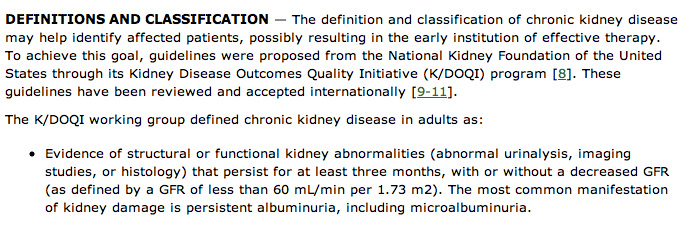
    This goes for other area where a link out makes sense. Here is a segment of UpToDates card on "Overview of the management of CKD in Adults"


    Wouldn't you expect, reference 8 to take you to the K/DOQI guidelines. They are free and available on the internet. UpToDate instead links to their internal reference of the AJKD supplement with the original publication of the K/DOQI guidelines, which are behind an Elsevier pay wall.


    It feels that the editorial rules for UpToDate were created in the CD-ROM era of the 90's and haven't been updated for the internet era.

    I beleive that, just as Harrison had an openning in the Internal Medicine textbook space by using patient oriented complaints to organize his text and Rose had an openning by using search and a unique editorial style, the technology of today provides a niche. I want an interactive textbook of medicine with comments, a Facebook "Like" button, a way to connect with other practitioners and share treatment pearls.

    The renal fellow network and other knowledge focused medical blogs are early progenitors of this future but some pretty large problems need to be addressed:

    • Organization. Blogs are reverse chronologic order by convention but given the random way that topics get posted, it makes for an unorganized structure. Solutions that are being used now include search and tags. Unfortunately, the tag clouds are so huge that they border on the useless. Search is good but a more structured table of contents and/or index would be great. I am delighted with the addition of the lecture and handout tabs on PBfluids, its a step that allows, at least me, to find things I have posted here before.
    • Expiration of old data. Medicine is always evolving. Today's truth is tomorrow's MMR-autism fiasco. These medical blogs need a way to mark expired information as such. A perfect example is the ATN trial by the VA and NIH. Prior to that study I was firmly in the more dialysis for acute kidney injury camp. After that was published I marked my acute kidney injury lecture, as being pre-ATN trial. This meant something to me, but my readers likely had no idea what that meant. How many other educational resources were obsoleted by that medical about-face?
    Nephrology on demand looks like they are another group making good progress in this mission. Look out UpToDate, Web 2.0 has you in our sights.


    - Posted using BlogPress from my iPad

    Saturday, November 14, 2009

    UpToDate can be so entertaining, I mean deceptive

    I am working on a review of membranous nephropathy and I found this quotation from UpToDate:
    A random urine protein-to-creatinine ratio should NOT be used for initial risk stratification, since the relationship between the ratio and 24-hour protein excretion varies widely among patients (show figure 2).
    This surprised me. I use the protein-to-creatinine ratio all the time and, though I have found some individuals where it is wildly inaccurate, I had been unaware of any data that showed that to be the case.

    I eagerly clicked the link to the figure and this is what I found:


    That looks highly accurate to me. Every data point clusters right along the line of identity. I pulled the abstract (alas, no full text from NEJM 1983) and found this conclusions from the authors:
    In a study of 46 specimens we found an excellent correlation between the protein content of a 24-hour urine collection and the protein/creatinine ratio in a single urine sample.
    I love UpToDate but this is really disappointing. Making a claim and referencing it with data which disproves the claim is disingenuous.

    UpToDate, you need to do better.

    Wednesday, May 27, 2009

    UpToDate evidence based medicine or not? Not.

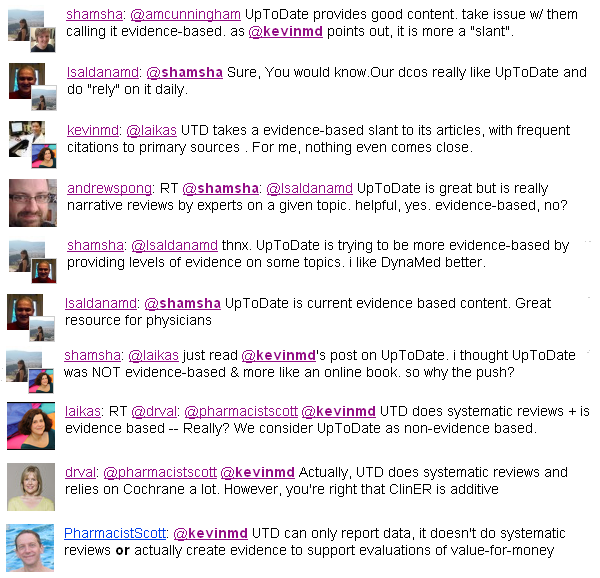
    A few months ago medical blogger Laika wrote an insightful blog entry summarizing a meme which had been bouncing around twitter regarding whether UpToDate was evidence based medicine or some other entity.


    I found the whole excercise to be a bit too philosophical for me. Regardless of what you call it I think everyone would agree that UpToDate is useful. It is a great starting place but usually insufficient as a single source.

    I was reminded about it today when I came across this paragraph:

    In the card on "Clinical manifestations, diagnosis, and natural history of primary biliary cirrhosis." (Link for subsribers)

    Regardless of the merits of UpToDate, nothing breaks the illussion of evidence based medicine like an author throwing out a random statistic like "approximately 15% of the 1,200 patients who I have seen..." without a reference. This is the epitome of expert oriented experiential medicine and has no place in EBM.

    Wednesday, January 28, 2009

    When did Up to Date get formatted for the iPhone?

    Last July when I went to use UpToDate on the iPhone it used the traditional PC website so it was very slow and ill suited to the iPhone. I went to use it a few days ago and it had been reformatted to the iPhone and was fast and clean.

    I tap on the UpToDate icon to launch Safari and go straight to UpToDate. The icon is called a webclip. You can learn more about this at this Apple webpage.


    Then I log in with my username and password.


    Look at how simple the search page is. It loads nearly instantly.


    The results load fast and are way easier to read than on the previous site.


    You then get an outline of the subject. Burton Rose calls them "Cards."


    Then you arrive at a manuscript that reads great on the iPhone screen.


    Even foot notes pull up the reference and abstract.
    Related Posts Plugin for WordPress, Blogger...