Showing posts with label potassium. Show all posts

Monday, January 30, 2017

FERE: Fractional excretion of random electrolytes

Magnesium:


  • 142 controls: 1.8% (range 0.5-4%)
  • 74 hypomagnesemic
    • Extra-Renal origin 1.4% (range 0.5-2.7%)
    • Renal origin 15% (range 4-48%)
  • Authors conclusion: >4% per cent is indicative of inappropriate renal magnesium loss

Potassium

  • 312 normal subjects: 8% (range 4-16%)
  • 84 hypokalaemic patients
    • Extra-renal origin: 2.8% (range 1.5-6.4%)
    • Renal origin: 15% (range 9.5-24%)
  • Authors conclusion: >6.5% per cent is indicative of inappropriate renal potassium loss

Friday, January 31, 2014

hypokalemia and metabolic alkalosis

A few years ago I was talking one of my mentors at Kidney Week, John Asplin. He mentioned
that he taught an integrated lecture on metabolic alkalosis and hypokalemia. I thought this was an inspired idea.

Teaching separate classes on both subjects results in a lot of overlap because the renal mechanisms for both disease are the same, this means that many of the diseases that cause one, also cause the other.

Additionally hypokalemia can cause metabolic alkalosis and metabolic alkalosis can cause hypokalemia, so it makes sense to teach both of these conditions in an integrated lecture.

Lastly, teaching each electrolyte individually in isolation from each other is a missed opportunity. One can only appreciate the beauty of electrolyte physiology when one understands how each electrolyte fits together and how abnormalities in one is associated and affects all of the other electrolytes.

Unfortunately, I botched the lecture. I gave this lecture for the first time for the Oakland University Beaumont Medical School this past August. I knew it didn't go too well, but this week I received the class feedback. Overall my statistical evaluations were excellent but when I read the comments the students were jackals. They savaged this lecture.


Timing was on my side, I was scheduled to give this lecture the day after I received feedback. I'm not done tweaking it but what I did for my Tuesday lecture was add more connective tissue between the concepts, and fill in with some additional summary slides.

Right now, I'm using it as a lecture to follow-up my potassium lecture, but at OU the students didn't have any baseline potassium knowledge. In order for this lecture to work the students must already understand the basics of potassium, especially the central role that renal potassium handling has in potassium homeostasis. Hopefully I will be able to negotiate another hour into the GU schedule for this lecture.

My next plans for this lecture is to cut out a lot of the opening slides. The purpose of those slides is to quickly move from introducing potassium and hypokalemia to getting to the truth that hypokalemia is almost solely a disease of increased renal losses.

I want to add a slide about disease opposites:
  • Pseodohypoaldosteronism type 1 and Liddle syndrome
  • Godon's syndrome and gittleman's syndrome
  • Adrenal insufficiency and AME
I want to add some slides on how hypokalemia causes (specifically, maintanes) metabolic alkalosis and then how metabolic alkalosis causes hypokalemia.

Here is the lecture (Keynote version | PDF)

Tuesday, January 7, 2014

Pseudohyperkalemia

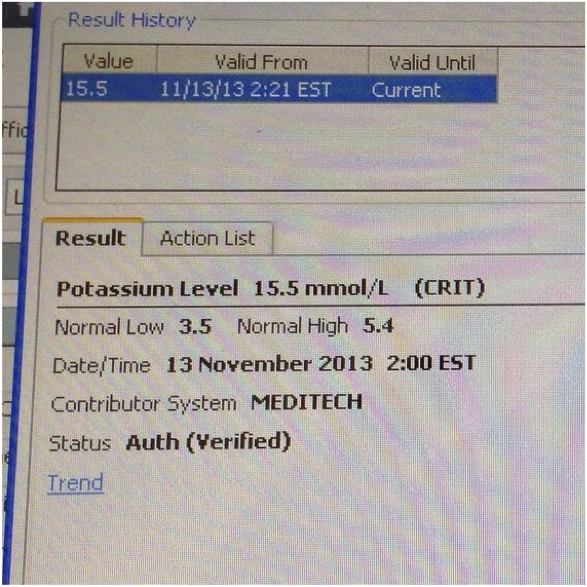
The highest potassium I have ever seen? That would be 15.5 mEq/L.


It's not real. It was pseudohyperkalemia from leukocytosis. The patient had chronic lymphocytic leukemia with a white count of 300,000. If you are not familiar with this condition, check out these posts on Renal Fellow Network: Westervelt and Nate. Nice full text references here and here (pdf).

The pseudohyperkalemia merit badge

The first time I saw this was when I was senior resident. I was sleeping in the call room my pager buzzed. It was the oncology floor with a potassium of 9. The patient had CML and was in a blast crisis. His leukocyte count around 100,000. I immediately suspected pseudohyperkalemia and ordered a whole blood potassium from the ABG lab. It was normal so I went back to sleep. The next morning I received an angry call from the Hemo-Onc fellow. The patient was coding and he was furious that I only ordered an ABG instead of treating the hyperkalemia.

I don't know if the patient coded from hyperkalemia, but I wish that I had gotten out of bed and evaluated the patient. I solved the problem the nurses alerted me to, but if I assessed him, maybe I could of averted an arrest.

Regrets...

Monday, September 5, 2011

Hyperkalemia or not

A patient came to the hospital with a swollen arm. The ED suspected a DVT and ordered a doppler ultrasound which confirmed their suspicion. The admission labs included a chem-7 which revealed a potassium of 7. Her creatinine was 1 and she wasn't taking an ACEi, ARB, aldactone, ketoconazole, or potassium supplements. The ER was surprised and repeated the study and checked an EKG:

Narrow QRS and unimpressive T-waves

The EKG gave no hint of hyperkalemia, though EKG changes are not a sensitive marker for hyperkalemia. The ED gave insulin, glucose and Kayexalate for the lab finding of hyperkalemia. We were consulted to determine the cause of the hyperkalemia. The patient's past medical history was significant for primary thrombocytosis and during the hospital stay her platelet count rose to over a million.

dats a lot o'platelets
We presumed that his hyperkalemia was actually pseudohyperkalemia due to the high platelet count. Platelets release potassium when they clot and the risk of pseudohyperkalemia rises as the platelet count approaches a million.

You remember this classic NEJM article from 1962. 
We then sent the patients blood to the ABG lab in a heparinized syringe rather than a red top and the potassium normalized. Platelets release potassium when they are activated. By measuring the potassium in whole blood rather than serum, the contribution of platelet activation is prevented. The ABG results are the electrolytes to the far left in the screen-grab below (click to enlarge).


- Posted using BlogPress from my iPad

Saturday, May 28, 2011

Highest TTKG with hypokalemia

Patient with a lifelong history of hypokalemia. He came to me for a second opinion, his previous nephrologist had been nudging up his potassium dose on every visit and the patient was now on 70 mEq of KCl daily and was getting uncomfortable with endlessly increasing doses of potassium.

At the time I saw him these were his labs (he had decreased his potassium supplementation to 20 mEq/day):

  • Blood
    • sodium: 128
    • glucose: 90
    • potassium: 2.8
    • Creatinine: 0.9
    • BUN: 11
    • Magnesium: 1.8
    • Calculated osmolality: 265
  • Urine 
    • sodium: 135
    • potassium: >100
    • Osmolality: 637

Trans-tubular potassium gradient: 14.9. That's crazy high for a patient with hypokalemia, one should expect it to be less than 2 for hypokalemia of extra-renal origin, and only 7 or 8 for hypokalemia from hyperaldosteronism. Halperin et al. were not able to get the TTKG that high even when they took normokalemic patients and doped them with fludrocortisone and 50 mEq of oral potassium. 

And that 14.9 is assuming the urine potassium is 100, our lab doesn't do serial dilutions so who knows what the actual potassium is? 120? 140?

I'm still waiting for the renin and aldo but I smell some Bartter's

Thursday, January 27, 2011

Quotation of the week

I go slow when replacing potassium. I mean, they do use that stuff to execute people.

Jason Ye- orthopedic surgery intern
via Chinita Furiosa

Monday, January 24, 2011

Pregnant Gitelman Patient follow-up

Last week I posted on my pregnant patient who has Gitelman's Syndrome. I am managing her with amiloride and a mixture of oral potassium and a mixture of oral and IV magnesium.

I received the following letter from a reader who went through a similar experience:
I am not a doctor, but I have Gitelman's, and 16 years ago, was pregnant and ended up having to go on amiloride at the start of my second trimester, because my potassium and magnesium levels just tanked.   Being part of proving the track record on the viability of amiloride in pregnancy was a scary time, I tell you what.  Your patient's experiences are similar to mine, though I did not require the magnesium IVs she apparently does during gestation. 
The great news is my son turned out healthy, and without any sign of potassium disorders of any sort, so far as we can tell at nearly 16.  He's healthy, bright, nearly 6 ft - no indication at this time  that he was harmed in any way by the fetal exposure to amiloride. 
And another point to pass along - after he was born, I had my breast milk checked for traces of amiloride, and it passed whatever screens were applied. Therefore I nursed him for about 9 months, though I supplemented with formula.  It was an acceptable risk for me - since I know the literature does not record any data on nursing while on amiloride, I thought I'd pass along one uncontrolled anecdote for you to ponder. [Note: on further communication the patient clarified that she did not take amiloride during breast feeding
Anyway, please pass this information along to your patient - I am sure it will help her peace of mind to know another successful long term outcome.  It was a scary time for me, and without the widespread use of Internet back in 1995, the only piece of mind I got was by tracking down Dr. Almeida, who wrote the 1989 paper about Gitelman's in pregnancy.  I spoke to one of his nurses to see if they could give me some info on long term followup on the baby, but the mother had disappeared after giving birth, and they had nothing to report.    
Best of luck to your patient - I know what she's going through. 
Final note for your patient going forward: Getting my levels back up after the birth was a bit of a challenge, I recall.  But many of the details have been lost to time and the fog of war, I'm afraid - I will just say that the first month post-partum was pretty rough on me.

Thursday, January 20, 2011

Gitelman syndrome and Pregnancy

One of my Gitelman patients (whom I kidding, "one of my Gitelman patients", how about "my only Gitelman patient") finally got pregnant. We had been managing her with amiloride and a truck load of oral potassium and magnesium supplements. I was shocked to find that amiloride is acceptable in pregnancy with a track record of successful births. Prior to starting amiloride the patient was taking twenty-eight 20 mEq pills of KCl a day. She abandoned her prior nephrologists when she was told to further increase her potassium pills.

from UpToDate
We are now using magnesium sulfate infusions 4 grams twice a week to keep her magnesium north of zero. She was able to keep her magnesium around 1.4 with oral supplements and amiloride prior to being pregnant but now, despite 8 grams of weekly IV magnesium her magnesium is sitting around 1.1. This probably represents one of downsides of the up-regulated GFR of pregnancy.

Interestingly, she saw her labs and saw that her sodium was 132. Modest hyponatremia is a normal finding in pregnancy, so she decided to increase her dietary sodium intake. Bad move, increased renal sodium loads increases renal magnesium losses. Her serum mag fell 30% to 0.8.


Friday, May 7, 2010

Hyperkalemia as an indication for dialysis

A few weeks ago we admitted a patient who has been approaching ESRD for a number of years. Most of her medical care had been provided in the hospital as she bounced from admission to admission. Though we tried to get her into our CKD clinic she always failed to show up. You can track the progression of her CKD from hospitalization to hospitalization with a gradually increasing baseline creatinine.

On this most recent admission, she came in with the triple 8s:
  • Hemoglobin 8.8
  • Creatinine 8.1
  • Potassium 8.6
Here is her initial EKG with that potassium:


The most remarkable part of the EKG was the profound bradycardia, heart rate of 30. Also she has beautifully peaked T waves. I'm surprised by the lack of a prolonged QRS. She had a great response to medical management with her K falling to the 5s. The repeat EKG was rather unremarkable.


The patient received dialysis on the day of admission and the following day I set her up for chronic dialysis. Whenever a patient progresses to chronic dialysis from CKD I always try to remind myself of how rare this event is. As nephrologists it is too common and seeing that unfortunate outcome alters our perception so that we may overestimate its frequency. End-stage renal disease is an exceptional, not a routine outcome of CKD. The vast majority of patients with CKD ultimatly expire of something other than renal failure. Let's review three important studies to emphasize this:

Keith et al looked at the five-year outcome of 28,000 patients with chronic kidney disease. He divided them by CKD stage and found that of the 11,278 patients with CKD stage 3, only 1.1% of then received dialysis and 0.2% received a transplant. A quarter of them died (24.3%). The authors summarized the results:
The likelihood of renal replacement therapy, either transplant or dialysis, was near zero (≤1.3%) for patients in all stages except stage 4, where 2.3% ± 1.1% of patients received a transplant and 17.6% ± 2.7% had dialysis initiated.

Eriksen et al found similar results in a 10-year study, with a 4% risk of renal failure for patients with CKD stage three compared to a 51% risk of death.


And lastly, O'Hare, et al's VA study that looked explicitly at renal failure and the competing outcome of death. They asked, "At what age and GFR is renal failure more likely than death?". Obviously, at a younger age, when death is a more remote possibility, a higher GFR will have the time to deteriorate to the point of requiring renal replacement therapy. The results showed surprisingly low GFRs:

To read the graph, find your patients age and then line it up with their GFR. If the intersection is in the black, they are more likely to die, if it is in the grey then hello Mr. Fresenius, nice to meet you Ms. Tacrolimus. Note, that in a 75 year old with a GFRas low as 16 mL/min, death is still more likely than ESRD.

So, the next time you see a patient initiating dialysis after a long run of chronic kidney disease don't be frustrated by the fact that they didn't do enough to prevent this, be amazed that they survived to this outcome. 

Friday, March 19, 2010

Aldosterone escape versus Aldosterone breakthrough

Fluid and electrolyte deity, Robert Schrier,  had an interesting editorial in Feburary's Nature Reviews: Nephrology (yes, I've gotten a little behind in this blogging business).

Escape versus breakthrough refere to completely different and unrelated concepts related to aldosterone.
  • Aldosterone breakthrough occurs following administration of an ACEi or ARB. ACEi block the conversion of angiotensin I to angiotensin II. The decrease in angiotensin II lowers aldosterone. Angiotensin receptor blockers prevent angiotensis II from from binding receptors through out the vasculature but including the adrenal gland where it prevents aldosterone release. At least that is the plan. In reality about 30-40% of patients given ACEi or ARBs have only a temporary decrease in aldosterone and then after a few weeks, aldosterone returns to pre-treatment levels.  


  • Aldosterone escape is a physiologic phenomenon that occurs with hyperaldosteronism. Aldosterone initially decreases urinary sodium increasing sodium retension contributing to hypertension. This does not result in edema because the sodium retention is short lived. After a short time urinary sodium returns to normal through a process called aldosterone escape. There are two processes that account for this:
    1. Pressure natriuresis. Increased blood pressure decreases distal sodium resorption. The exact mechanism of pressure natriuresis is unknown, it is thought to be mediated by hydrostatic forces. Increased blood pressure is transmitted to the peritubular capillaries, so the resorption of solutes must overcome an elevated hydrostatic pressure gradient. In the face of this increased gradient, sodium resorption falls.
    2. Decreased proximal sodium resorption. Volume expansion decreases proximal sodium reabsorption and increases sodium delivery to the distal nephron and overwelms the aldosterone induced sodium resorption.
The implications of aldosterone escape is that primary hyperaldosteronism does not cause edema. It also explains the delay in hypokalemia found with primary hyperaldosteronism. Aldosterone stimulates potassium excretion but hypokalemia is a late finding in primary hyperaldosteronism. The increased potassium excretion occurs with aldosterone escape when the increased sodium delivery (decreased proximal absorption, i.e. escape) occurs with the increased aldosterone levels.

Friday, March 12, 2010

Kayexalate: risks and benefits

When I was a fellow I got an opportunity to write the chapter in Intensive Care in Nephrology on Disorders of Potassium Homeostasis.


Dr. Murray, the editor and my fellowship program director, told me that I couldn't use review articles or text books as references. It was a golden experience. I systematically went through all of the pearls I had collected on potassium and drilled down to the original data.

The primary conclusion I had after months of exploring the stacks of The Crerar was that the wall of knowledge that I had assumed backed up all of our clinical practices was more like a chain link fence with isolated points of solidity but mostly holes. Science could provide a rough outline but too much of medicine is based on conjecture and reasoned guesses.

One of my finds was the near total lack of data showing cation-exchange resins to be effective. In the chapter I wrote:
...Two recent studies have questioned the effectiveness of SPS [sodium polysterene] resins, but until larger studies corroborate these findings, SPS resins remain part of the therapy for acute hyperkalemia. (106, 122, PDF) SPS and sorbitol usage have rarely been associated with intestinal necrosis; whether this is due to sorbital, the resin, or other factors is unclear. (123, 124, 125)
The key table from the Gruy-Kappal article showing the lack of effectiveness of SPS resins

This was actually the revised paragraph. The first draft was much stronger. I railed against the use of kayexylate given the lack demonstrated benefit and the emerging data on the dangers of this medication. I was ready to throw kayexalate on the hyperkalemic trash heep along with bicarbonate. My co-author, John Asplin calmed me down and had me moderated the section. He explained that despite the lack of data, SPS resins have a long history of use and explained that though I have the option of using dialysis, intensivists often find themselves in binds where dialysis is not available and they need an extra-renal method for potassium clearance.

I can appreciate Asplin's wisdom now. In the last decade I have used SPS resins innumerable times in patients with and without ESRD, though my data is circumstantial I am believer in the effectiveness of this drug. I hope the latest publicity about the purported ineffectiveness of Kayexalate leads to well done large studies rather than a loss of this effective medicine.

Tuesday, December 8, 2009

Great resource on potassium

kind of an "everything you wanted to know about potassium but were afraid to ask."


I especially love the two Nobel prizes in the top corner. Pauling is one of only four people to win two. In an alternate universe Linus got a couple of breaks to beat Watson and Crick to the structure of DNA. In that universe he has three Nobels and walks around like Michael Phelps.

Friday, July 10, 2009

My first two lectures to the IM Intern Class of 2012

On July first I gave a lecture on IV fluids, total body water and hyponatremia. This handout is similar to the lecture I give to the medical students titled sodium and water. It adds a half baked section on potassium but this handout really needs to have th sodium section tightened up and shortened, the potassium section finished and short sections on the treatment of phos, magnesium and calcium disorders.
  • Here is the PDF
  • Here is the native Pages documentin case you use Pages and are interested in finishing this work in progress.
On July 9th I gave a lecture on acute renal failure. The handout is 28 5.5 x 8.5 pages. The book is designed as a workshop with questions and points for discussion throughout.
  • Here is the PDF of the 28 page handout. It is very readable and one of the best handouts I have put together.
  • Here is the native Pages document in case you use Pages and are interested in editing my masterpiece.

Sunday, April 12, 2009

Its not the sodium intake its the sodium:potassium ratio

Don't worry only about sodium intake (NYC, I'm looking at you) and its not just potassium intake (DASH diet in the cross-hairs). It's all about the sodium potassium ratio. This is shown by Cook et al (PDF). during reanalysis of the Trial of Hypertension Prevention I and II. This trial had serial 24-hour urine collections done in 2,275 patients with pre-hypertension in the late 80's and 90's. The investigators looked at that data through the lens of 15 years of follow-up to determine the risk of cadiovascular events:
In observational analyses of the mean urinary excretion during 11⁄2 to 3 years, we found a suggested positive relationship of urinary sodium excretion and a suggested inverse relationship of urinary potassium excretion with risk of CVD, but neither was statistically significant when considered separately. Both measures strengthened when modeled jointly, with opposite but similar effects on risk. However, the sodium to potassium excretion ratio displayed the strongest and statistically significant association, with a 24% increase in risk per unit of the ratio that was similar for CHD and stroke and was consistent across subgroups.
Here is the key figure. Note in the graph the rate of events is presented on a log scale so the 2 indicates a rate 100 times the rate at zero.

Friday, April 10, 2009

What's new in Potassium: sudden cardiac death

As the Nephrology Fellow Network recently covered the etiology of cardiovascular disease in dialyzors is unique from the general public. Use of statins, the foundation of preventative cardiology, has repeatedly failed to prevent cardiovascular vascular disease (CVD) among dialyzors. One reason for this, is the propensity for these patients to die of sudden cardiac death (a lethal heart rhythm requiring a shock of electricity or luck to reverse) rather than acute myocardial infarction (heart attacks). In this study (PDF), from Italy, the investigators found that nearly half of the cardiovascular deaths were due to sudden cardiac death (SCD). The authors retrospectively looked at their data to find risk factors for SCD.

They prospectively looked at 476 patients in 5 Italian hemodialysis units. The cohort was tracked for 3 years and had 167 deaths (35%), 32 due to SCD and 35 due to other CVD. On multivariate analysis they found the following risk factors for SCD:
As important as what was significant, is what was not significant. Left ventricular hypertrophy, heart failure and valvular heart disease, all important risk factors for SCD among non-dialysis patients were not associated with SCD in their cohort.

The most interesting analysis was when they parsed out the day of the week the patients died of SCD. Instead of looking at the absolute day they related the day to the patients dialysis schedule. I have modifed their chart to reflect this, with twin X-axis: one for MWF and another for TTS patients.
The red line indicates how high the bars would be if there was no relationship to the dialysis schedule. The highest risk periods were the 24 hours before dialysis at the beginning of the week and the 24 hours after the dialysis at the beginning of the week. Not dialyzing for the two days over the week-end put patients at risk for SCD both before and after subsequent dialysis.

This sounds like an electrolyte associated complication rather than a uremic toxin because of the risk after dialysis, indicating the change in the toxin, not just the high level, is a risk-factor. This is supported by studies (1, 2) of potassium modeling in which the potassium in the dialysate is lowered sequentially during dialysis. By modeling the potassium, the speed of potassium removal is decreased. This has been shown to decrease pre-mature ventricular contractions (a benign momentary disturbance in the heart rhythm that is being used as a proxy for more serious arhythmias, like SCD. Medicine has gotten in trouble with this proxy in the past so it may not be appropriate.).

Summary: modestly high potassiums are associated increased SCD and the two day dialysis holiday on traditional three day a week dialysis is likewise associated with SCD. Hello daily dialysis!

The lecture on Potassium that this entry was drawn from:

Wednesday, February 25, 2009

Internal Medicine Board Review: Fluids, Electrolytes and Acid Base

The chief resident at Providence asked me to do a board review class for the third-years. They have small sessions weekly (?) in the physician lounge. This afternoon we went over fluids, electrolytes and acid-base. We did the first 14 questions. Seems like it went pretty well.

Monday, December 22, 2008

Fluid and Electrolyte lecture at Providence from Tuesday Dec 16

I did a lecture at Providence last week.

I was scheduled to just give a electrolyte lecture without any further guidance. I pulled out two interesting cases I had seen in the last few weeks. Both patients have a non-anion gap metabolic acidosis, but one is hypokalemic and the other is hyperkalemic.

Here is the native Powerpoint files for you to use or edit.

Here is the SlideShare for online viewing

Monday, October 13, 2008

Teaching Medical Students: Potassium

A couple of Fridays ago I did my second lecture for the medical students at Providence Hospital. I lectured on potassium.

The handout is good but gets a little light on content towards the end. I will revise this before the next lecture.

Potassium for Med Students

Potassium booklet form for printing
Potassium handout for iPhone
Related Posts Plugin for WordPress, Blogger...