Showing posts with label anemia. Show all posts

Wednesday, January 18, 2012

Crazy numbers: largest drop in hemoglobin without a transfusion

A drop in hemoglobin on 9 grams brings to mind the old surgical maxim "all bleeding stops" but I just had a case of a drop that big that includes three other confounding factors:
    1. He is a dialysis patient
    2. He didn't died 
    3. He didn't required a transfusion
He is a 58 year old patient with ADPKD, as part of this disease he had polycythemia and the day he was admitted with a chief complaint of dyspnea he had a hemoglobin of 19 g/dL. He had been advised that this was dangerous and he should go for phlebotomy. Sure enough he had a bilateral PE and multiple DVTs.


We started unfractionated heparin and ordered phlebotomy. So the next morning when we saw the decrease in the hemoglobin from 19 to 14 I was satisfied that he had a good response to phlebotomy. In reality, he never received the phlebotomy.

On that next hospital day he reported worsening flank pain. We ordered a CT to evaluate this and to help evaluate why his PD was failing. Turns out the pain and falling hemoglobin were due to a large bleeding renal cyst and renal hematoma. We stopped the heparin. The hemoglobin fell to 10 g/dL, a tidy 9 gram drop. We transferred him to the MICU. The initial plan was to embolise the bleeding kidney but the hemoglobin stabilized after stopping the heparin. After a few days of expectant testing and nervous observation we resumed the heparin and the hemoglobin held.
While we initially attributed the DVT solely to the erythrocytosis, he has a troubling family history (in addition to the ADPKD) that suggests thrombophilia.

Tuesday, January 10, 2012

My first post at eAJKD

As part of my role as a board member of the eAJKD I was able to interview Iain Macdougall regarding his survey of emerging and novel anemia therapies in AJKD. It was a fun interview and I'm proud of how the post turned out. Check it out.

Monday, November 7, 2011

Crazy numbers: the lowest hemoglobin I have ever seen

When I was a resident I saw a really low hemoglobin. I don't remember what the number was but I remember the circumstances. I was working the ER at Riley Children's hospital and EMS pulled up with a infant who was short of breath. The family had been feeding him cows milk instead of formula and as a result he had severe iron deficiency anemia. Great case and after a few transfusions and some parental education, everyone lived happily ever after.

Last week I saw another lowest hemoglobin. Since I wasn't blogging when I was a resident I don't know if this hemoglobin is lower than that poor kid but here it is:


Hemoglobin of 3.6 g/dL. The hematocrit is still a double digit number, but still that's a really low hemoglobin.

This is a dialysis patient who started having some vomiting that looked a little "dark" but didn't really bother him. A day or so later he developed some dark colored diarrhea. Still didn't bother him. Then he found himself short of breath, like he missed a treatment and got volume overloaded. This kept getting worse so he finally decided to get in his car and drive to the ER. The admitting hemoglobin was 3.7 followed by a repeat by I'm sure a disbelieving ER doc.


Diagnosis duodenal ulcer and after a half dozen transfusions and a prescription for BID omeprazole he was discharged home to lived happily ever after.

Wednesday, September 14, 2011

New kid on the block: The Kidney Doctor

I first met Ajay Singh when he came to St John Hospital as part of a symposium on chronic kidney disease in 2004 or 2005. It was a great meeting and Singh gave two memorable lectures.

The first was a dismantling of the MDRD equation as an accurate measure of GFR. He was speaking against an equation that was way better than a simple creatinine but had some real problems, especially when used in patients without kidney disease. It was a inflammatory and a bit wonky for a conference directed to primary care doctors. Here we, the local nephrologists, were trying to get our doctors to recognize occult CKD by abandoning serum creatinine in favor of the superior eGFR and then the invited expert comes in and tells them how stupid this is.

His second lecture was the correction of anemia dog-and-pony show. He gave an amazing and persuasive presentation in favor of correcting of anemia in renal disease. Though the data was all retrospective and observational it was clear that Dr. Singh was personally a few steps past equipoise. At the time CHOIR was in full swing recruiting and retaining patients and my group was part of that process as a research site for CHOIR.

Five or so years later he returned to talk with our fellows and staff regarding anemia. This was after the publication of CHOIR, but I believe before the release of TREAT, though my memory is a bit hazy on the timing.

What I do remember is that he talked about the dangers of correcting anemia and the lack of data supporting its use. I remember being so angry. I felt that for the last half dozen years I had worked to convince my CKD patients that they needed to enroll in our anemia clinic, needed to come to our office for EPO shots and iron infusions, and that all this would make them feel better, protect their heart and prolong their life, all purported advantages of ESA therapy. And now Mr. Harvard returns and tells us that this is wrong, without ever apologizing, without even mentioning how he'd jumped the fence.

I stopped him mid-lecture and told him that the last time he'd been in Detroit he'd been telling us how important it was to treat anemia and now he had completely changed positions. Dr. Singh paused, looked at me, and gave the best answer possible. I can't remember his exact words, so I'm paraphrasing here,
"The data has changed. Now we know more and what I'm telling you is what is currently correct. In medicine, there is no room for intellectual loyalty. We must be loyal to our patients not our theories. The reason my position has changed is that I am following the data. Would you want me to do anything else?"
His answer completly satisfied me and it extuinguished my rage. I was better able to deal with my regret and embarrassment at having to abandon a long held belief and practice pattern at the feet of new data.

His new blog is off to a flying start with a productivity that hasn't been seen since Nate Hellman and quality that, to my eyes, no one can match.

Thanks Ajay, I'm looking forward to following your blog.

Saturday, August 20, 2011

Calling all nephrologists! If you care about anemia, you have until August 30th


The Centers for Medicare and Medicaid Services has proposed changes in the Quality Incentive Program (QIP) for 2013. The changes specifically involve anemia. The QIP was created to assure that even though the costs of providing dialysis care are born exclusively by the dialysis provider, there are specific quality goals that if not met result in financial penalties. The quality goals currently place are:
  • Percentage of Medicare patients with an average Hemoglobin < 10.0g/dL (Hemoglobin Less Than 10g/dL Measure)
  • Percentage of Medicare patients with an average Hemoglobin > 12.0g/dL (Hemoglobin Greater Than 12g/dL Measure)
  • Percentage of Medicare patients with an average Urea Reduction Ratio (URR) ≥ 65 percent (URR Hemodialysis Adequacy Measure).
Dialysis units that fail to hit the goals perscribed by the quality score receive a reduction in the Medicare payment by 0.5-2%. It should be apparent that the required hemoglobin targets ares problematic, especially given the recent action by the FDA (see my recent post Between a rock and a hard place). CMS is proposing the elimination of the floor on hemoglobin targets:
...Therefore, for the PY 2013 ESRD QIP, we propose to continue to use the following two measures previously adopted for the PY 2012 ESRD QIP:
  • Hemoglobin Greater Than 12g/dL Measure.
  • URR Hemodialysis Adequacy Measure.
This feels wrong to me. Creating an economic incentive that puts the cost of treating anemia on the provider but doesn't provide any minimal goals may result in a race to the lowest hemoglobin. What's to stop a rogue dialysis unit from removing ESAs from their formulary. We can all freely admit that ESAs have some previously under appreciated risks and that our enthusiasm for treating anemia was not entirely evidence-based, but our response to should not be to turn back the calendar to 1988.

After the release of Epo, the transfusion rate plummets. It falls by two thirds in a year and continues to fall so that the current rate of 0.3% per quarter represents a 98% reduction in transfusions. Revolutionary. And this doesn't even begin to address the quality of life brought to dialysis patients by higher hemoglobins.
CMS states that they cannot add another unique quality indicator for 2013 and are looking toward 2014 to do this. In the absence of new quality guidelines they should keep the goal to maintain a hemoglobin over 10 g/dl but lower the target to 9 g/dL for 2013.

Patients deserve an incentive that keeps providers conscious of anemia. In study after study, low hemoglobins walk hand in hand with poor outcomes. The concern regarding anemia has been driven by attempts to normalize hemoglobin. It is clear that normalization is hazardous and without scientific support; however a failure of the experimental group does not mean we should abandon the therapy given to the control group. In every study the control group received ESA to maintain hemoglobins at least 9 g/dL.  Removing the hemoglobin floor from the quality measures would be giving a de facto license to withhold an important medication from dialysis patients.
The TREAT trial is the best study every done on outcomes in CKD with an ESA.
These dosing groups resulted in an effective separation in hgb with little profound anemia

I have copied this post to Regulations.gov as my comment on the latest guidelines.
The deadline for comments is August 30th.


A science liaison at Amgen told me that Amgen was advocating for a hemoglobin floor of 10 g/dl. The Renal Physician Association is also supporting a hemoglobin of 10 g/dL. [This paragraph was updated 8/22/11, after a complaint that I mis-interpreted Amgen's position. My apologies.]

I have heard that CMS has received few comments from physicians. Embarrassing. Anemia is important and nephrologists should care how the governments crafts incentives that will change how our patients are treated. Go now and comment. Tell CMS what you think.

Wednesday, July 27, 2011

Davita: is the vial half empty or half full

Early Tuesday, I caught half a headline about drugs being wasted at the expense of Medicare and to the benefit of some dialysis company. A few hours later I saw the first caustic tweets:


Just some of the angry tweets
Then I started getting direct messages asking for my thoughts. Recently, Davita has been getting more than its share of bad press recently and this seemed like more of the same. The facts of the news story, as far as I can tell, are as follows
  • A former medical director and nurse brought a whistle blower suit against Davita
  • They accuse Davita of using large vials to administer IV drugs during dialysis. The large vials resulted in excess medication being wasted
  • Medicare pays for the entire vial regardless of how much is wasted
  • The Justice department investigated this claim for more than two years and decided not to join the lawsuit
My first reaction was Davita had done a bad, bad deed here but the more I thought about it, the more that seemed to be a rush to judgment. The fact that the Justice Department, after investigating  for two years, did not join the lawsuit became the itch I could not ignore. My interpretation, is that the Feds looked into how Davita was handling the drugs and they did not find any unlawful activity.

So I was satisfied with the assumption that the way Davita was handling the drugs was legal. However, even when things are within the letter of the law we want our medical institutions to use resources efficiently. Clearly, intensionally pouring drugs down the biohazard drain, as the whistle blowers contend, is not the most efficient use of medical resources. The problem was the Medicare reimbursement system. For years, Medicare underpaid for the dialysis procedure so that dialysis providers had to turn themselves into high-end retail pharmacies that peddled Epo, and Zemplar in order to keep the lights on. With this type of system the providers were incentivized to use as much drug as possible. This perversion of fee-for-service has been at the root of almost all of the recent scandals in dialysis units. The recent anemia controversies were driven to the forefront largely because dialysis companies were payed for giving drugs not for patient oriented outcomes.

Its clear to me that retail pharmacy system was not the system we wanted. The laws need to change and you know what? This system is no longer the law. Bundling began earlier this year and removes these perverted incentives in order to better align provider and patient goals. In response to the new incentives you know what happened? The vials became right sized and Epo use plummeted. It's too early to see how bundling effects patient outcomes but Davita and the other Large Dialysis Organizations are responding to the new incentives.

The lesson here is that incentives drive medical decision making. Incentives need to be implemented thoughtfully because small, seemingly minor holes can be blown wide open and introduce major distortions in the delivery of care. In terms of this whistle blower case, I think we shouldn't dwell on the cows leaving the old barn that has been replaced by one with automatic and secure doors. The old reimbursement system was broken and has been fixed (or at least changed) and I don't think there is much to be gained by dwelling on the previous system's inefficiencies and errors.

So as I see it:
  • Davita administered and wasted dialysis drugs in a way that is uncomfortable, and inefficient but legal.
  • The Government realized the incentives were not aligned with better outcomes and changed the incentives
  • Davita and the other large dialysis organizations have changed their purchasing and administration procedures in response to the new incentives
  • A couple of former employees want to sue Davita for its legal, but opportunistic, drug handling behavior under the old incentives


Transparency: I am a part owner of a dialysis joint venture with Davita and one of my partners, Robert Provenzano, is Davita's VP of Medical Affairs.

Saturday, July 23, 2011

The problem with numbers, the curse of intermediate end-points

The curse of treating chronic kidney disease is that one is always treating patients to the numbers:
  • Blood pressure. I need to get my patients below 130/80
  • Cholesterol. I need to get their LDL below 100
  • Metabolic bone disease. I need to keep their PTH
    • KDOQI 
      • Stage 3: 35-70
      • Stage 4: 70-110
      • Stage 5: 150-300
    • KDIGO
      • In patients with CKD stages 3–5 not on dialysis, in whom serum PTH is progressively rising and remains persistently above the upper limit of normal for the assay despite correction of modifiable factors, treatment with calcitriol or vitamin D analogs is suggested. (hey KDIGO, thanks for the guideline)
  • Diabetes. I need to keep their Hgb A1c less than 7
  • Anemia. I need to keep their hemoglobin
But these numbers are all intermediate, and from a patient perspective, pretty abstract. Patients don't get PTH angina. Targetting the numbers is a way to shift the odds toward better patient outcomes, to load the dice in the patient's favor. However we cannot allow the numbers to substitute for the real goals of care. I don't really care about your blood pressure, I just want to prevent the heart failure, dementia, kidney failure, stroke and erectile dysfunction that result from the high blood pressure. If you give me a pill that magically improves the blood pressure but doesn't avoid those end-points I'm not interested.

But as the number game has become a larger part of medicine we are getting medications that are pursued and approved only for their ability to fix the numbers. Some have been super successful, statins have repeatedly and reliably shown their ability to reduce events in lockstep with reducing the cholesterol. Lately however, it is feeling like success of the statins to reduce LDL and also reduce cardiovascular events maybe more the exception than the rule.

The recent experience with ESAs and hemoglobin have been beat to death in the nephrology community. See this post for a deep dive. The core issue, is that low hemoglobins are bad for patients, but using ESAs to improve the hemoglobin does not mitigate the risk. And not only does it not mitigate the risk, it appears that the current agents bring with them novel arterial and venous thrombotic risks.

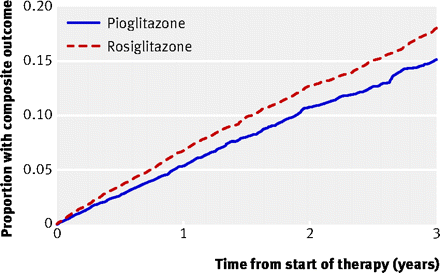
The experience with A1c seems to be playing out using a similar script. Glitazones were approved based on their ability to reduce blood sugars. They effectively lower blood sugar but Rosiglitazone increased the risk of cardiovascular death by 64% and was associated with increased composite outcome of stroke, heart failure and total mortality compared to pioglitazone.


And June 9th pioglitazone was pulled from the shelves in France for increased risk of bladder cancer. A position validated by the FDA on June 15th.

This comes on the heals of three studies in 2008 and 2009 that question the notion of very tight (less than 7%) hemoglobin a1c targets to improve patient outcomes.

In cardiology, following the stunning success of statins and LDL we have a string of failures, Ezetimibe (Zetia/Vytorin) for LDL and niacin/torcetripib for HDL

I often feel the only reason we still treat PTH is that no one has done the study to show that it helps and when we get around to that trial, I'm looking at you Abbott, we will find that it too, has been a waste of money and attention.

Tuesday, July 5, 2011

The new definition of a rock and a hard place--Updated

The rock would be Amgen with their newest prescribing information for Epogen and Aranesp. The recommendations for dialysis patients can be summarized as:
Specifically, for patients on dialysis, the label advises physicians to initiate ESA therapy when the hemoglobin level is less than 10 g/dL and guides physicians to reduce or interrupt the dose when the hemoglobin approaches or exceeds 11 g/dL.  So target a hemoglobin higher than needed to prevent transfusions and no higher than 11 g/dL.
The hard place would be the federal government whose Quality Improvement Plan (QIP) for dialysis units states:
The intent is to control anemia and maintain optimum hemoglobin levels within the range of 10-12 g/dL (grams per deciliter).  Anemia management will be assessed by two separate measures: 
  1. CMS will assess the percentage of patients whose hemoglobin levels dipped under 10 g/dL.  The program assigns this measure the greatest weight in facility performance calculation, because numbers under 10 g/dL are highly undesirable.  (Weight = 50%)
  2. CMS will assess the percentage of patients whose hemoglobin levels exceeded 12 g/dL. Numbers greater than 12 g/dL could suggest unnecessary or excessive administration of certain drugs.  (Weight = 25%)
There is little air to breathe between 10 and 11 g/dL. Something has got to change and my guess is by the end of the year QIP will be suggesting hemoglobins between 9 and 10.

UPDATE: CMS has proposed new rules that remove the lower limit for hemoglobin as a quality measure. Here is some news coverage and here is the PDF.

I think its crazy to remove the lower hemoglobin limit. When CMS introduced the bundled payment system they turned anemia management from a profit center to a cost center for dialysis units. The Quality Incentive Plan was designed to prevent dialysis units from minimizing costs by denying patients adequate treatment. It seems that with the 2013 proposal, a Machiavellian dialysis unit could eliminate anemia management completely and reap financial rewards without penalty.

This can't be right, at the least CMS should add minimizing transfusions as a quality measure, that would reconcile the prescribing information and the quality goals.

Hat tip to the anonymous first poster.

Friday, June 10, 2011

Epo, anemia and the lack of placebo controlled trials

By a mistake of communication I was scheduled to give the anemia talk at a recent chronic kidney disease symposium. I would have never selected this topic on my own. I work with Robert Provenzano, one of the Gods of Anemia. Fortunately, this was a happy accident. I loved researching and writing this presentation. The whole experience was an important lesson on the value of working out of your comfort areas.

The anemia saga is well known to all nephrologists and is covered in depth in my presentation but let me recap my version of the story.

Life before Epo was pretty bad. the average dialysis patient received a transfusion more years than not. On the Eve of Epo the transfusion was rate was 16% per quarter!
After the release of Epo, the transfusion rate plummets. It falls by two thirds in a year and continues to fall so that the current rate of 0.3% per quarter is a 98% reduction in transfusions. Revolutionary. And this doesn't even begin to address the quality of life brought to dialysis patients by higher hemoglobins.

I was in college when this happened and it's a little hard to imagine how exciting that must have been.  The introduction of Epo launched a million observational trials that all pointed in the same direction: 

Where you found higher hemoglobins you found better patient outcomes. 

It almost didn't matter what outcome you were interested in: hospitalizations, mortality, regression of left ventricular hypertrophy, quality of life, fatigue score. It didn't matter, everything was better with higher hemoglobins. I suspect the community was seduced by the observational results but for what ever reason the amount of randomized controlled trial data that emerged was laughably small. By 2007, Epo was eating up 1.8 billion Medicare dollars. It should have been the best studied drug and instead it was among the least studied.
I tried to find Henry Paulson's signature but had to settle for George Bush's.
Here is the table from K/DOQI anemia recommendations where they summarized all of the RCT data from the birth of Epo through May 2006 (apparently it omits a single 2005 study).

8 Epo vs Epo studies and 3 placebo controlled trials, 1 placebo controlled trials in pediatrics

The paucity of placebo controlled trials is shocking. No one demonstrated that higher hemoglobin targets had a mortality benefit or regressed LVH compared to placebo. This would not be so problematic if the Epo vs Epo studies had been positive, but those too were negative trials. So we are in the awkward position, a quarter century after the introduction of EPO we cannot conclusively state that the drug does any more than reduce transfusions and improve quality of life. All the mortality reductions, cardiovascular disease protection amount to observational-backed hype (one small rct (N=38) study did show a reduction in LVH).
Favorite slide from the deck

Part of me is outraged but another part understands how difficult it would be randomize dialysis patients to placebo. I couldn't, in good faith, expose trial subjects to the transfusions, fatigue and weakness that being randomized to the placebo-arm would entail. It fails my personal "Grandma test" (i.e. Would you feel comfortable enrolling your grandma in a placebo controlled trial of Epo? No). I understand that and forgive the dialysis researchers; however I am a little disturbed to witness how in the pre-dialysis CKD population the same pattern of relying on observational data. In CKD these is no transfusion epidemic that needed to be derailed, there is no profound fatigue turning patients to zombies. We had an opportunity to do the right studies to figure out if this expensive Nectar of Thousand Oaks really helped. The paucity of placebo controlled and randomized controlled trials in pre-dialysis patients is embarrassing.

Reading this editorial by Marc Pfeffer crystalized this critical mistake. I spent a fair proportion of the presentation laying out how statins evolved from being used in only the sickest patients to larger and larger populations and how at each step placebo controlled trials were used to prove efficacy. Not every step was a win, statins for heart failure failed, but the key is that cardiologists know that statins don't improve heart failure because they tested it with two (1, 2) placebo-controlled trials.

Why is nephrology lacking the randomized controlled trials that have defined the huge advancement in cardiovascular disease over the last 25 years?


  • It isn't due to the severity of illness, the first placebo controlled trial of ACEi in heart failure used a cohort with 40% mortality at 6 months. 
  • It isn't timing, ACEi for heart failure was developed and proven at the same time as the introduction of Epo.
I don't know the why but I have a couple of theories. One is the richness of the retrospective data in nephrology, brought to us by the USRDS, blinds us to the importance of prospective data. This could explain why are repeatedly burned by observational studies, see: kT/V, vitamin D, and binders.

The other theory is that, unlike statins and ACEi where there are many vendors producing drugs in the class of interest, there is a total monopoly in the field of ESA. You want to increase the hemoglobin you need to buy Epogen. No generic, no competing ESA. In the ACEi market, having enalepril as the drug studied in the CONSENSUS and SOLVD trials paid huge dividends to Merck. Having in-class competition lead to commercial support of critical research. Amgen had no need for this because the US Patent Office gave them a monopoly. A monopoly that seems to last forever. Why is it that every other drug from the late 80's is generic: omeprazole, captopril, enalepril, benazepril, metformin, simvastatin, etc. Even drugs from the 90's are now generic: losartan, lansoprazole. 

Epogen stands alone without generic competition. And unfortunately, largely without placebo controlled trials to back-up mountains of hype.

The deck can be found here: Keynote | PDF

Wednesday, November 3, 2010

Post transplant erythrocytosis

I have a 35 year old patient who recently received his second kidney transplant. He received his first transplant in his 20s in Albania after going into renal failure due to SSG (that's Some Sort of Glomerulonephritis, a typical diagnosis for a patient who emigrates to the US with a failing transplant and little medical history).

Soon after his transplant his hemoglobin began to rise. We initiated phlebotomy when his hemoglobin rose above 19.

His hemoglobin fell to 17.2 but then increasd up to 18.5.

I started 5 mg of enalepril and it fell to 16.9.

I increased the enalepril to 10 mg and it fell to 16.2 and continued to fall until it is now around 14.

Wednesday, August 26, 2009

Another one bites the dust: TREAT is negative

Darbepoeitin meets a similar fate as epoetin alpha in CKD patients. Here is the press release from the trial onset, a more opportunistic time:
Amgen Inc. (Nasdaq:AMGN), the world's largest biotechnology company, today announced that the company has initiated a landmark trial to evaluate the impact of treating anemia on cardiovascular outcomes in patients with chronic kidney disease (CKD) and type 2 diabetes. TREAT (Trial to Reduce cardiovascular Events with Aranesp(R) (darbepoetin alfa) Therapy) is one of the largest clinical trials in the company's 25-year history. The TREAT study design as well as additional Sensipar(R) data was presented at the American Society of Nephrology (ASN) annual meeting in St. Louis.

"Current research suggests that anemia is an augmenter of cardiovascular risk in individuals with CKD and type 2 diabetes," said TREAT lead investigator Marc Pfeffer, M.D., Ph.D., chief of medicine at Brigham and Women's Hospital and a professor at Harvard Medical School. "TREAT will be the definitive study to determine if treating anemia with Aranesp does, in fact, lower the risk of death and non-fatal cardiovascular events in individuals with CKD and type 2 diabetes."

TREAT is an international 4,000 patient, multicenter, randomized, double-blind, placebo-controlled trial. The primary endpoint of TREAT is a composite index of time to mortality or non-fatal cardiovascular event, including myocardial infarction, myocardial ischemia, stroke and heart failure.

The rational for TREAT was published in the American Heart Journal. From the abstract:
BACKGROUND: Patients with chronic kidney disease (CKD) have a high burden of mortality and cardiovascular morbidity. Additional strategies to modulate cardiovascular risk in this population are needed. Data suggest that anemia is a potent and potentially modifiable risk factor for cardiovascular disease in patients with CKD, but these data remain unsubstantiated by any randomized controlled trial (RCT). Furthermore, the clinical practice guidelines for anemia management in patients with CKD are based on limited data. The need for new RCTs to address critical knowledge deficits, particularly with regard to the impact of anemia therapy on cardiovascular disease and survival, is recognized within the guidelines and independent comprehensive reviews of the existing published trial data.
STUDY DESIGN: The Trial to Reduce Cardiovascular Events with Aranesp (darbepoetin alfa) Therapy (TREAT) is a 4000-patient, multicenter, double-blind RCT, designed to determine the impact of anemia therapy with darbepoetin alfa on mortality and nonfatal cardiovascular events in patients with CKD and type 2 diabetes mellitus. Subjects will be randomized in a 1:1 manner to either darbepoetin alfa therapy to a target hemoglobin (Hb) of 13 g/dL or control, consisting of placebo for Hb > or =9 g/dL or darbepoetin alfa for Hb <9> or =9 g/dL. TREAT is event-driven and has a composite primary end point comprising time to mortality and nonfatal cardiovascular events, including myocardial infarction, myocardial ischemia, stroke, and heart failure. TREAT will provide data that are critical to evolution of the management of cardiovascular risk in this high-risk population.
This was the last nail in the coffin for use of ESAs to normalize hemoglobin in pre-dialysis CKD. In the years since CHOIR and CREATE one of my partners kept holding out hope for TREAT. He mentioned that TREAT made it through its interim safety monitoring without being stopped so it was unlikely to show the same detrimental findings found in CHOIR.

This data is just preliminary as it was published to satisfy financial requirements. The official results will likely be presented at Renal Week.

Thursday, January 15, 2009

IV Iron in Hemodialysis

Steven Fishbane, MD from The University of Pennsylvania, came to our fellowship program to discuss Fe and hemodialysis. He began by talking about hepcidin and then went on to discuss the iron targets in light of the DRIVE trial and then touched on IV Fe and proteinuria and finished with a discussion of platelets and mortality and its relationship to recent anemia trials.

He started by talking about why Fe deficiency is so prevelant among CKD and dialysis. As an explanation he did a brief overview of Hepcidin.

Fe is a powerful growth factor for bacteria.
During an infection the body decides to withold Fe.

Inflammation leads to increases in hepcidin which increases ferritin.
Hepcidin decreases intestinal iron absorption and increases Fe sequestration in RE system. The end result is a decrease in serum Fe and TSAT.

DRIVE Study by Daniel Coin and Morin was designed to see if giving Fe in patients with a high ferritin and low TSAT was effective.

Enrollment:
  • Hgb less than 11
  • ESA over 22,500 U/week
  • Ferritin 500-1200
Ave TSAT 18, Ferritin 761, CRP 27, Hgb 10.3, ESA 34,000 U/wk

All patients had their ESA bumped 25% and randomized to either 1g of Fe or placebo.

The primary end-point was a change in hemoglobin over 6 weeks. The hemoglobin rose 10.2 to 11.3 in control and 10.4 to 11.9 in the Fe group over 6 weeks.

47% of the treatment group had an increase in hemoglobin of 2g versus 29% in the control group.

DRIVE-II by Kapoian

6 week follow-up after the randomized trial. Observational
Hgb increase was sustained despite the Fe group getting the Epo cut by 20% with no change in the in the epo dose of the control group.

Ferritin initially rose to 934 from 760+.

No different in responce in the patients with ferritin 500-800 vs 800-1200.

TSAT was not predictive of response low TSAT and high initial TSAT had the same response.

Prospectively studies cannot find link between IV Fe and infection.

Here is some criticism of the DRIVE study by the National Anemia Action Council:

The purpose of the DRIVE study and its six week extension, DRIVE II, was to determine the efficacy and safety of supplemental intravenous iron in anemic hemodialysis patients receiving recombinant erythropoietin who had a transferrin saturation <> 500 ng/mL. The intravenous iron group did increase their hemoglobin levels slightly more than control patients not given intravenous iron without additional toxicity, leading the authors to conclude that intravenous iron in this situation was both safe and effective. Unfortunately, the design and power of both studies were not sufficient for the investigators to reach these conclusions.

First, the decision to increase the dose of recombinant erythropoietin in each group by 25 % confuses the response to ESA and iron. In a chronic inflammatory state, such as chronic renal disease, the problem is not impaired iron availability but insufficient erythropoietin, which is required to mobilize iron and upregulate transferrin receptor expression. It is well recognized that erythropoietin trumps hepcidin in this situation and the authors merely confirmed that phenomenon.

Second, in the control groups of both DRIVE and DRIVE II, there were a disproportionate number of women, who are more likely to be iron deficient, and their response to recombinant erythropoietin proved this, reducing the effectiveness of comparisons.

Third, both DRIVE and DRIVE II were open label observational studies and in addition physician discretion was also allowed with respect to erythropoietin dosing and iron administration. This discretion can introduce significant bias, weakening the conclusions of the studies.

Fourth, no attempt to estimate blood loss, iatrogenic or otherwise, was made for either experimental group. Fifth, the difference in the hemoglobin level achieved with supplemental iron was not striking and also pushed the hemoglobin level above that currently recommended for safety reasons. Finally, since the serum ferritin and transferrin saturation increased in the iron-supplemented group, a state of iron overload was achieved that was unnecessary and the 12 week observation period was certainly not long enough to exclude the possibility of iron-induced organ toxicity.

It is clear that more data derived from larger prospective trials that are conducted for longer periods are needed. Until this data becomes available, anemic hemodialysis patients not responding to conventional doses of recombinant erythropoietin, in whom the serum ferritin is greater than 500 ng/mL, should first be evaluated for a source of blood loss or infection. Then the patient should be given a higher dose of recombinant erythropoietin for a minimum of 6 weeks with serial transferrin saturation and ferritin measurements before resorting to intravenous iron supplementation.


Fishbane then spoke about the possibility of proteinuria induced by iron sucrose. He showed the Agarwal data on proteinuria and IV iron. He stated that with out knowing how long the proteinuria lasted it was impossible to guess if this was important clinically.

Platelets in Nephrology

Fe deficiency causes reactive throbocytosis
ESAs raises platelets
ESAs cause fe deficiency

Increased RBC push platelets along the walls of the blood vessel. So treatment may cause a lot of atherothrombotic complications because they have both more platelets and red cells.

In DRIVE 20% drop in platelets with Fe treatment.
Streja Et al. used the Davita retrospective database to show a nice human association of TSAT and platelets with thrombosis. Importantly he showed no increase in mortality for Hgb over 13 when the data was controlled for the platelet count. Dr. Fishbane was unable to suggest a how one could design a prospective RCT to test this theory.

Sunday, December 21, 2008

Great cases on call

I'm running the on-call gauntlet.

I was on call Sat and Sun December 6,7
Sat December 13
Sat and Sun December 20,21
Thursday through Sunday December 25-28
four straight week-ends, with Christmas thrown in for the Jew. Ughh.

That said this week-end has had a few great cases:
  • IgM Cold-agglutinin hemolytic anemia in need of plasmapheresis.
  • Fluconazole induced hyperkalemia
  • Urinary obstruction induced electrogenic type 1 RTA (Hyperkalemic variety of type 1 RTA)
  • Primary hyperaldosteronism induced hypertensive emergency
I'll elaborate on some (all) of these cases in the next few days.

Happy holidays

Saturday, July 5, 2008

Teaching on 2 Ell: Anemia and CKD

Late post from June.

Near the end of the month our fellow the amazing Dr Jabri gave a lecture on anemia. Good talk.

Here are his lecture notes.

Monday, June 30, 2008

My fellow just answered a question I have had for years.

Part of the dogma of evaluating iron deficiency in patients with anemia is that after a transfusion the iron indices are altered. Over and over the question comes up...
How long after a transfusion do you have to wait before checking to see if the patient is iron deficient?
Well Jabri, my current fellow went to the literature and found this reference. It looks like the answer is you should be safe 48 hours after the transfusion. This surprised me, I expected the acute effects of the transfusion to persist longer than that.

Abstract from the paper:

The effect of transfusion of packed red blood cells on serum iron level, total iron-binding capacity, and transferrin saturation was studied. Samples of blood from 37 hemodynamically stable patients were obtained for analysis at various intervals following the transfusion of packed red blood cells. In 10 patients with possible iron deficiency, a significant rise in serum iron level and transferrin saturation occurred during the 24 hours following transfusion, which persisted at a marginally significant level up to 36 hours. In the remaining 27 patients, a significant rise was also noted in serum iron level and transferrin saturation results, but the rise did not persist beyond the 24 hours after transfusion. No change in total iron-binding capacity was noted in either group. These data show that the diagnosis of iron deficiency (based on a transferrin saturation of < 0.16) might be missed if iron studies are performed on patients within 24 hours following packed red blood cell transfusion. Therefore, if serum iron studies are obtained for patients suspected of having iron deficiency anemia, these studies are best done on blood samples obtained before blood transfusion.
Related Posts Plugin for WordPress, Blogger...