Just a few weeks ago I was writing about the
first patient data on the use of sirolimus in ADPKD. After years of being teased with promising animal data
Perico et al. finally showed that sirolimus may help humans with ADPKD. That study was the first human data and so I forgave the fact that it was small, used a cross-over rather placebo design and was short in duration. And lastly it failed in its primary end point of total kidney volume but it showed less cyst volume (P=0.0558) and an increase in renal parenchymal volume (P=0.0089).
I had no idea that the next human data would be so quick in coming. Last week, the New England Journal of Medicine published two randomized, open label, controlled trials on the use of mTORs for ADPKD. Unfortunately, neither of them were encouraging.
The first article looked at everolimus, a newer mTOR inhibitor. It is by
Walz et al. They looked at 392 patients and randomized to everolimus or placebo (double-blind) and maintained for 2 years. Patients had to have ADPKD and a GFR between 30 and 89 mL (Stage 2 and 3 CKD) or a GFR >89 and a kidney volume of 1,000 mL. Everolimus was titrated to keep trough levels between 3-8 ng/mL.
The primary end point was a change in kidney volume by MRI. The data showed decreased kidney volume with everolimus at 12 months but the advantage was no longer significant at 24 months.
Estimated GFR did not improve with everolimus:
Our linear regression model predicted a steep annual decline in the estimated GFR among patients receiving everolimus, owing to the significantly accelerated deterioration in renal function between months 6 and 18. However, the estimated GFR did not differ significantly between the everolimus group and the placebo group at 2 years.
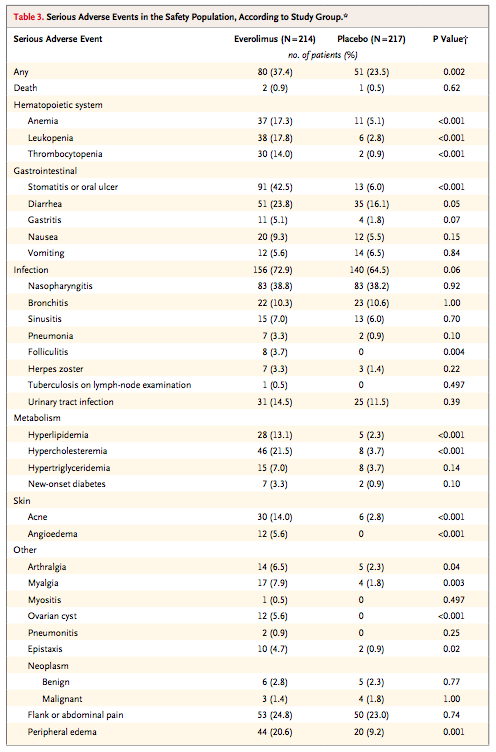
The study also found a host of serious adverse events among the patients on everolimus. The ones found significantly more often with everolimus were:
- Any
- anemia
- leukopenia
- thrombocytopenia
- stomatitis
- diarrhea
- folliculitis
- hyperlipidemia
- hypercholesterolemia
- acne
- angioedema
- arthralgia
- myalgia
- ovarian cyst
- epistaxis
- peripheral edema
I was interested to see angioedema on the list as we had recently gone over a paper suggesting
increased angioedema in transplant patients where sirolimus was implicated. During the discussion I had mentioned that this side effect would be important in the ADPKD trials. Walz et al. found a 5.6% rate of angioedema.
The second trial was by
Serra et al. and was an 18 month, open-label, randomized controlled trial of 100 patients. They used sirolimus rather than everolimus. The study focused on patients with earlier disease, requiring a eGFR greater than 70 for enrollment. Patients had a 6 month run-in after enrollemnt where they needed to show 2% increase3 in kidney volume inorder to be randomized.
The results were not impressive:
And in their own words:
We found no significant difference in total kidney volume after 18 months of treatment with sirolimus, regardless of the patient’s age, sex, or albumin:creatinine ratio at randomization or whether they were receiving therapy with an ACE inhibitor or an ARB. Our estimate of the ratio of kidney volume in the sirolimus group to that in the control group rules out any clinically meaningful reduction in total kidney volume with the use of sirolimus.
I thought the accompanying
editorial by Watnick and Germino was excellent. One of the primary points of the editorial was that this human, interventional data calls into question the use of change in kidney volume as being the ideal intermediate end-point.