Last Thanksgiving weekend, many bloggers participated in the first documented “blog rally” to promote Engage With Grace – a movement aimed at having all of us understand and communicate our end-of-life wishes.
It was a great success, with over 100 bloggers in the healthcare space and beyond participating and spreading the word. Plus, it was timed to coincide with a weekend when most of us are with the very people with whom we should be having these tough conversations – our closest friends and family.
The original mission – to get more and more people talking about their end of life wishes – hasn’t changed. But it’s been quite a year – so we thought this holiday, we’d try something different.
A bit of levity.
At the heart of Engage With Grace are five questions designed to get the conversation started. We’ve included them at the end of this post. They’re not easy questions, but they are important.
To help ease us into these tough questions, and in the spirit of the season, we thought we’d start with five parallel questions that ARE pretty easy to answer:
Silly? Maybe. But it underscores how having a template like this – just five questions in plain, simple language – can deflate some of the complexity, formality and even misnomers that have sometimes surrounded the end-of-life discussion.
So with that, we’ve included the five questions from Engage With Grace below. Think about them, document them, share them.
Over the past year there’s been a lot of discussion around end of life. And we’ve been fortunate to hear a lot of the more uplifting stories, as folks have used these five questions to initiate the conversation.
One man shared how surprised he was to learn that his wife’s preferences were not what he expected. Befitting this holiday, The One Slide now stands sentry on their fridge.
Wishing you and yours a holiday that’s fulfilling in all the right ways.
To learn more please go to www.engagewithgrace.org. This post was written by Alexandra Drane and the Engage With Grace team. If you want to reproduce this post on your blog (or anywhere) you can download a ready-made html version here
Wednesday, November 25, 2009
Friday, November 20, 2009
I was taught that to live a long healthy life avoid alcohol and take your vitamins
Turns out that seemingly sound advice will kill'ya.

Any drinking lowered the risk of heart disease but the more patients drank the greater the protection. And the amount they drank was pretty staggering:

Headlines from this week:

- light drinking, about a glass of wine or 1.5-beers per day, reduced risk by 35%
- moderate drinking, 2 glasses of wine or 2-3 beers reduced the risk 51%
- Moderate and heavy drinking, 5+ glasses of wine or 7+ beers, resulted in 54 and 50% risk reduction.
The health benefits of alcohol were touched upon in ths prior post.

Not only did the patients randomized to folic acid + B12 have a higher rate of developing cancer, they had a higher cancer mortality. Most of the cancer mortality came from excess lung cancer in the folic acid + B12 group. This was despite the fact that there were more smokers in the placebo group (38% vs 40% p=0.01). (JAMA)
The fall of folic acid was touched on in this prior post.
So parents, remind your kids to drink their beer and forget their vitamins.

Thursday, November 19, 2009
Today we did the recent NEJM CRT dosing article in journal club
The article is here.
Three of our attendings and fellows raved about Dr. Tolwani's AKI in the ICU lecture from Renal Week.
Here is the slide deck.
Three of our attendings and fellows raved about Dr. Tolwani's AKI in the ICU lecture from Renal Week.
Here is the slide deck.
Nephrotic syndrome + blood clots = membranous nephropathy
I have a patient with nephrotic syndrome, renal vein thrombosis and two pulmonary embolisms in the last year. I told him that the nephrotic syndrome was likely due to membranous nephropathy and that all of his various blood clots are due to the kidney disease. The biopsy came back today and it is indeed membranous nephropathy.
Membranous nephropathy is a common finding when patients are biopsied for nephrotic syndrome. Fortunately, it is a relatively benign disease with a significant number of spontaneous remissions. (Schieppati, NEJM 1993)


Since there are so many spontaneous remissions and the therapy has significant side-effects we risk stratify patients in order to spare low-risk patients from treatment.
Higher risk
Treatment recomendations are based on the probability of progression.
Low Risk
For patients with a low risk of progressing the recommendation is to stay and pray.
 These patient should be initiaed on the Ponticelli or modified Ponticelli protocol. This calls for three consecutive two-month cycles of cytotoxic therapy.
CJASN published an excellent review of membranous nephropathy (Medline).
Membranous nephropathy is a common finding when patients are biopsied for nephrotic syndrome. Fortunately, it is a relatively benign disease with a significant number of spontaneous remissions. (Schieppati, NEJM 1993)

Adequate renal function was defined as "no ESRD"

Since there are so many spontaneous remissions and the therapy has significant side-effects we risk stratify patients in order to spare low-risk patients from treatment.
Higher risk
- older age (over 60) (Medline)
- male sex
- nephrotic range proteinuria
- greater than 8-10 g/day for more than 6 months (PDF)
- increased serum creatinine (Cr over 1.5) (Medline)
Though the instinct after getting a kidney biopsy is to start therapy immediately, in patients with a normal creatinine, waiting for 6 months and monitoring the creatinine and proteinuria does not alter the patients response to treatment. (Medline)
The biopsy findings have long been held of major importance on predicting prognosis but an analysis of 389 biopsies questioned whether histology provided information that independently predicted prognosis. (Medline)
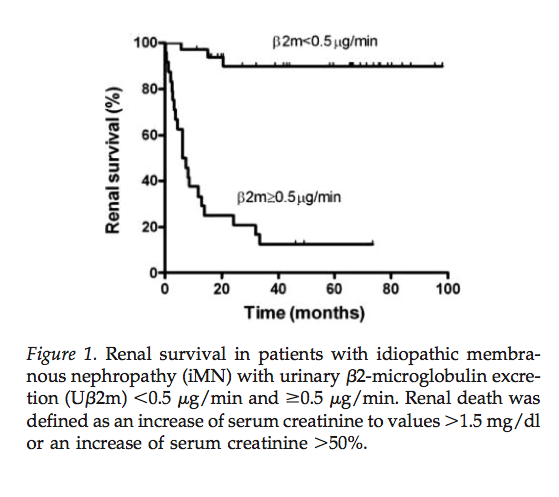
Two urinary findings are gaining acceptance at being able to better predict the clinical course of disease. Beta-2 microglobulin excretion greater than 0.5 mcg/min and IgG excretion over 250 mg per day (others use the more sesitive value of 125 mg/24 hours) have both been associated with increased risk of renal progression. (Medline)


Treatment
The biopsy findings have long been held of major importance on predicting prognosis but an analysis of 389 biopsies questioned whether histology provided information that independently predicted prognosis. (Medline)
Two urinary findings are gaining acceptance at being able to better predict the clinical course of disease. Beta-2 microglobulin excretion greater than 0.5 mcg/min and IgG excretion over 250 mg per day (others use the more sesitive value of 125 mg/24 hours) have both been associated with increased risk of renal progression. (Medline)

Treatment
Treatment recomendations are based on the probability of progression.
Low Risk
For patients with a low risk of progressing the recommendation is to stay and pray.
- Monitor the creatinine
- Institute non-specific antiproteinuric therapy (ACEi, ARB, aldosterone antagonists)
- Control the lipids
- Tight blood pressure control
Moderate risk
 These patient should be initiaed on the Ponticelli or modified Ponticelli protocol. This calls for three consecutive two-month cycles of cytotoxic therapy.
- Day 1-3: 1 gram of methylprednisolone. This is usually done as an inpatient.
- Day 4-30: Oral prednisone, 0.5 mg/kg daily
- Day 31-60: Oral cyclophosphamide 2 mg/kg (chlorambucil in the original Ponticelli)
High risk
Less data is available. Modified Ponticelli maybe appropriate but others recommend cyclosporin.
For patients with resistant disease there is no consensus on what is best and a list of what's been tried looks like a line up of the usual suspects, nephrology edition.
Subscribe to:
Posts (Atom)
