Sunday, December 20, 2015

Misplaced concreteness

Nephrology, more than other specialties is plagued by misplaced concreteness. We get false senses of precision because of the myriad of equations that spit out results to the milliliter. All of those equations from Kt/V, to water deficits, to IVF brain teasers depend on an estimate of total body water.

Everyone knows the rule of thumb that young males are 60% water, young females are 50% water and the percent body water falls as people age or get fatter.
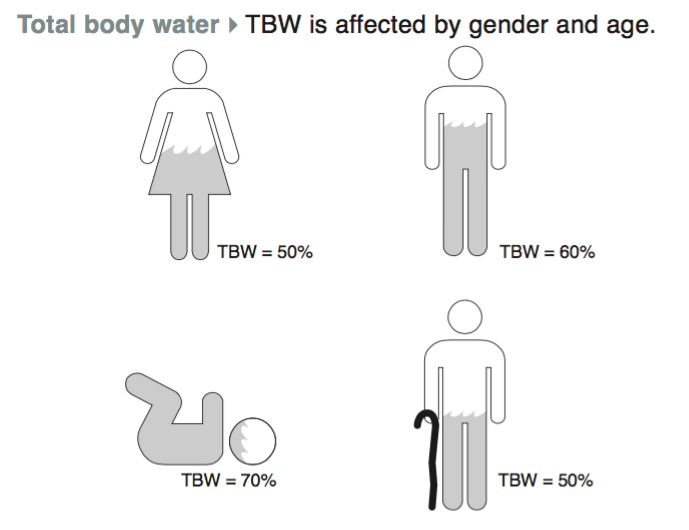


Going beyond these rules of thumb, how is total body water measured empirically? The gold standard is heavy water dilution.

This works by giving a sample of heavy water and then waiting for it to equilibrate. Then the investigators measure the heavy water content of exhaled water vapor or a blood sample, the fraction of the water that is heavy water will be equivalent to the fraction of total water which is heavy water. Then since one knows the amount of heavy water given to the patient, one can calculate total body water.

When this is done, or when one reviews the primary literature, as was done in this study the numbers are a little different.

The drop in total body water (in red) in men never gets down to 50% as predicted for the elderly, and in women almost all of the numbers are below 50% and the trend to lower percentages through aging holds if you ignore the 9 women over the age of 70. Of note, these patients are not that obese, see BMIs in blue.

The above study lead to the development of the Watson equation to determine total body water. The Watson equation uses age, weight and height for men and height and weight for women:

  • Males: TBW (in liters) = 2.447 + (0.09156 × age) + (0.1074 × height) + (0.3362 × weight)
  • Females: TBW (in liters) = –2.097 + (0.1069 × height) + (0.3362 × weight)


This study in peritoneal dialysis patients (peritoneum empty) showed surprisingly close relationship (R=0.92) between deuterium dilution and the Watson equation:


Another study of PD patients demonstrated one of my pet peeves, the major effect of obesity has on total body water.


The chart is a bit difficult to understand. The Y axis shows the Watson calculation of total body water minus heavy water dilution. So negative numbers indicates cases where the Watson method underestimates TBW. When the Y-axis is positive the Watson calculation overestimates TBW. The X-axis expresses obesity as body fat over body water. Really? fat over water. You couldn't just graph this versus BMI?


Wednesday, December 9, 2015

IV Fluid Brain Teaser: Salt versus Saline

Everyone knows that if you give a liter of saline, all of it remains in the extracellular compartment.

But what if you give a patient just the salt from the saline and none of the water? How much does the solute contribute to the increase in the extracellular volume? How does 154 mmols of NaCl affect the size of the extracellular and intracellular compartments?

Assume the patient is a 70 kg lean young male with a serum osmolality of 280 mOsm/kgH2O. Ignore any renal losses during the process.

For full credit fill out the following:

Total body water:
Size of the extracellular compartment:
Size of the intracellular compartment:

Tuesday, October 13, 2015

Please fund my #DreamRCT, it is just embarrassing how little evidence is found in hyponatremia

So I checked in at DreamRCT and noticed that my DreamRCT is no longer in the top five.


I'm a big boy and can take this (very minor) form of rejection but I do want to plead my case for a moment. You can read the entire description of my DreamRCT here. One of the dirty little secrets of nephrology is the almost total lack of prospective data on hyponatremia. There are a number of RCTs with regards to tolvaptan, conivaptan and other approved, and soon to be approved, vaptans. But after those there is an evidence desert populated by only a few mirages made up of case reports and retrospective analysis. From this scant data we have built a comprehensive and detailed model of how sodium acts in the body and the importance of osmoregulation. But thats like theoretical physics without a supercollider. We need to test the model with real data.

Think about the fact that hyponatremia is the most common electrolyte disorder. We order metabolic profiles on every patient, every day, but when it comes to interpreting those results we might as well be reading hieroglyphics.

RCTs are difficult and expensive but there are particular areas where we should require them prior to treatment. One of these corners is when we treat people with no symptoms and we are effectively treating a number. High cholesterol, high blood pressure, and low sodiums are three such areas, however hypertension and hypercholesterolemia have both gone through the right of passage called a randomized controlled trial. I am confident that my patients with asymptomatic hypertension benefit from treatment. My patients with coronary disease and hypercholesterolemia will live longer and better with treatment with a high potency statin. On the other hand, patients with sodiums of 129 and no apparent symptoms are supposed to be at higher risk of falls, have a higher mortality from heart and liver failure. Does treating them reduce these risks?

¯\_(ツ)_/¯


We can do better. Hyponatremia is the most common electrolyte disorder found in patients, we owe it to them to have real, prospective, data to answer these questions.

Go to UKidney to vote for my trial: No hyponatremia modification in asymptomatic hyponatremia. Thanks.

Friday, October 2, 2015

DreamRCT begins

DreamRCT is a creative writing project for nephrologists. The assignment is to scour the landscape of nephrology knowledge for a corner that is dominated by dogma and retrospective evidence. Once the target is identified, the writer needs to summarize the gaps, and think up a creative way to shine science's greatest flashlight on the subject, a randomized controlled trial.


We have recruited 16 people to submit DreamRCTs which were published today on MedPage Today. Thanks Ivan, Kristina and Elbert. It is a amazing collection of creativity; there are trials on kidney stones, electrolytes, dialysis, proteinuria and lupus. Please go check them out; read them and see which are great and which should be relegated to The Journal of Craptology.

After reading the DreamRCTs move on over to Jordan Weinstein's excellent UKidney where it is time to channel your inner Mark Cuban and play Shark Tank with the DreamRCTs.

Which trial should be funded which shouldn't. How much should each trial be awarded. You will get $100,000 to distribute among the trials. Think KickStarter meets NIH. You will not be alone in this endeavor. We have recruited an expert panel of clinical researchers to score the trials. At the conclusion of the contest we will look at how the experts spent their cash and how the crowd did. We will also award a small prize to the funder whose distribution best matches the expert panel.


DreamRCT only works if we get a critical mass of people to participate. Please check out the trials at MedPage Today and then go to UKidney to vote with your (completely virtual, don't ask me for a refund) dollars. Announce the project at morning report, assign your fellows to vote and then submit discuss and submit your own DreamRCT, because in the end DreamRCT is not just a game but a shorthand expression for what we need to do to fix nephrology and heal our patients.
Related Posts Plugin for WordPress, Blogger...