
The entire article is great and I recommend it but one aspect of the story was the rise of ductal carcinoma in situ. Here is how it is described:
Many of those women are told they have something called ductal carcinoma in situ (D.C.I.S.), or “Stage Zero” cancer, in which abnormal cells are found in the lining of the milk-producing ducts. Before universal screening, D.C.I.S. was rare. Now D.C.I.S. and the less common lobular carcinoma in situ account for about a quarter of new breast-cancer cases — some 60,000 a year. In situ cancers are more prevalent among women in their 40s. By 2020, according to the National Institutes of Health’s estimate, more than one million American women will be living with a D.C.I.S. diagnosis.The point is, our diagnostic technologies have found a "pre-disease" state and we now take credit for curing these people when they may never have developed the lethal form of the disease. A conversation on twitter erupted regarding D.C.I.S. and its equivalence in prostate cancer, another disease mired in controversy regarding diagnostics and the benefit of early diagnosis.
D.C.I.S. survivors are celebrated at pink-ribbon events as triumphs of early detection: theirs was an easily treatable disease with a nearly 100 percent 10-year survival rate. The thing is, in most cases (estimates vary widely between 50 and 80 percent) D.C.I.S. will stay right where it is — “in situ” means “in place.” Unless it develops into invasive cancer, D.C.I.S. lacks the capacity to spread beyond the breast, so it will not become lethal. Autopsies have shown that as many as 14 percent of women who died of something other than breast cancer unknowingly had D.C.I.S.
Must read: Mirrors Men & Prostate ca.Gleason 6 = DCIS --> don't call it cancerOur Feel-Good War on Breast Cancer nyti.ms/ZuCZHh
— David Y.T. Chen (@dytcmd) April 25, 2013
@kidney_boy @dytcmd I'm not buying the comparison. G6 tumors on biopsy are often upstaged (30%?) whereas I'm not sure DCIS is
— daviesbj (@daviesbj) April 25, 2013
Their is, in fact, a movement to re-name Gleason 6 tumors that avoids the term cancer as a way of emphasizing the low aggressivness of the condition:
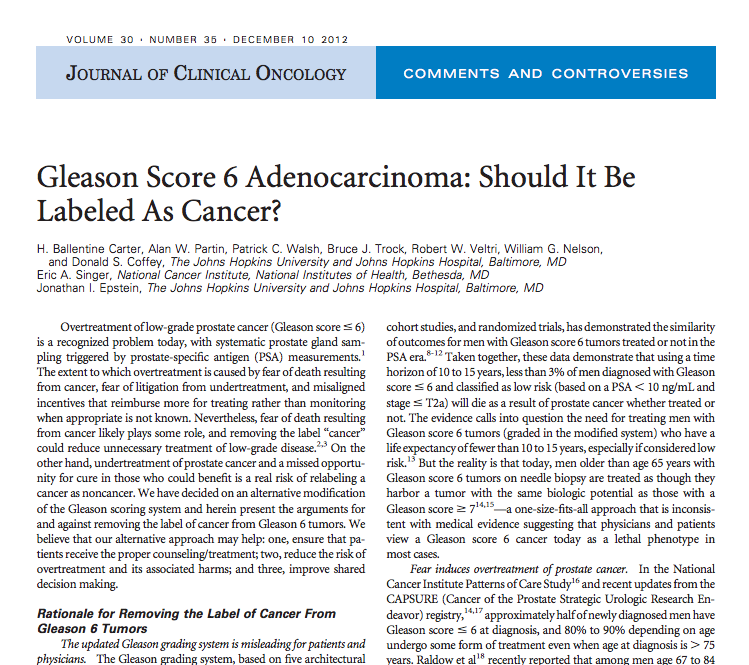 |
| Here it is in all its PDF glory |
In the absence of definitive markers of the lethal phenotype, a new paradigm is needed to express the risk associated with Gleason score 6 tumors. We propose to adopt at Johns Hopkins an alternative approach based on a modified Gleason scoring system referred to as prognostic grade group. Five prognostic categories will be reported based on prostate biopsy (Table 1). For men undergoing radical prostatectomy from 2004 to 2011, these prognostic grade groups from 1 to 5 have been associated with 5-year biochemical recurrence-free survivals of 94.6%, 82.7%, 65.1%, 63.1%, and 34.5%, respectively (Pierorazio et al, manuscriptin preparation).
This made me think, what is the DCIS or Gleason 6 of nephrology, and I think by far its CKD stage 3. New patients that are referred to me come in to the office with labs results in hand. They frequently have seen information on line or in posters that explain that their eGFR of 52 mL/min is CKD stage three and they see that Stage 5 is dialysis. So they come to two conclusions:
- They are going to be on dialysis soon
- Why didn't anyone ever warn them when they CKD stage 1 or 2?
The problem with using numbers to stage a condition is people reasonably expect a stepwise progression from stage 1 through stage 5. The reality is, if they have normal kidneys on U/S and a normal urinalysis, by far the most common situation, they have no kidney disease when their eGFR is greater than or equal to 60 and jumps to stage when their GFR falls below 60. Absurd. Additionally only 1% of stage 3 patient progress to dialysis.
 |
| From my GFR handout |
I am excited to see how the KDIGO guidelines and their heat map of GFR + Albuminuria perform as prognostic guides, but I would have been happier, if they had renamed CKD 3 as CKD stage 1 and using CKD stage 0 for GFRs greater than 60 ml/min plus evidence of renal disease.

Update from Twitter (where else?)
Amyloid_Planet: Nice blog post today BTW - bit off a lot with that one.
Kidney_boy: What? You think taking on Komen, the urologists'
cash cow and K/DOQI is a big post?
Amyloid_Planet: Potentially controversial, yes. I'm surprised you didn't take a shot at Jesus while you were at it.
Kidney_boy: follow-up post


